How to Build a Crypto Strategy for a Fear Market
Disclosure: This article contains affiliate links. If you sign up or make a purchase through these links, we may earn a commission at no extra cost to you.
Building a crypto strategy for a fear market is the difference between panic-selling at the bottom and buying the positions that define your next five years. In early April 2026, the Fear and Greed Index dropped to 8 — the lowest reading since the Terra-Luna collapse in June 2022.
By May 9, 2026, the index has climbed back to around 45 — still in the Fear zone, but no longer in free fall. Bitcoin is trading near $81,000, and institutional ETF inflows returned in March with $1.32 billion. The panic phase appears to be over. The uncertainty phase has not ended.
This is exactly the kind of environment where most beginners make their worst mistakes — and where disciplined traders build the positions that define their next five years. This guide will walk you through a complete strategy for navigating a fear market, step by step.
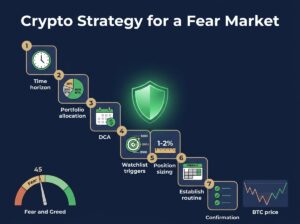
Why Fear Markets Destroy Beginners
Fear markets do not destroy portfolios through price drops alone. They destroy portfolios through behavioral mistakes triggered by price drops. Understanding these mistakes is the first step to avoiding them.
The first mistake is panic selling. When Bitcoin fell from $126,000 to $61,000 between October 2025 and April 2026, many retail investors sold near the bottom. The Fear and Greed Index hit 5 on February 6 — the lowest point of the entire year — which means maximum panic. Historically, every time the index has dropped below 10 since its launch in 2018, Bitcoin has delivered positive returns within 90 days. The average 90-day return following sub-10 readings is approximately +48%. Selling at peak fear means selling at the statistically worst possible time.
The second mistake is revenge trading. After taking a loss, traders often try to “make it back” by increasing position sizes or switching to high-risk altcoins. This almost always accelerates losses because the emotional state that drives revenge trading is the opposite of the calm analysis that produces good entries.
The third mistake is doing nothing. Some beginners freeze entirely — they stop buying, stop checking, and miss the recovery. Between April 3 and May 5, Bitcoin climbed from $67,000 to $81,000, a 21% move in roughly one month. Those who froze in March missed one of the fastest recoveries in 2026.
The solution is not courage or conviction. It is a system — a written plan that removes emotion from decision-making.
Step 1: Decide Your Time Horizon Before You Touch Anything
Your entire strategy depends on one question: are you investing for 1–3 years or trading for 1–3 months?
If you are investing for the long term (1–3 years or more), your primary tool is dollar-cost averaging. Price drops are your ally because they lower your average cost. Your biggest risk is not a 40% drawdown — it is selling during that drawdown and locking in losses permanently. A DCA strategy removes the need to time the market.
If you are trading on shorter timeframes, your primary tools are support and resistance levels, RSI signals, and strict risk-reward ratios. Your biggest risk is overtrading — taking too many positions in a volatile market where stop-losses get hit repeatedly.
Write your time horizon down. Tape it next to your monitor. Every decision you make should be filtered through that answer.
Step 2: Set Your Portfolio Allocation
In a fear market, your allocation should be more conservative than during neutral or greedy conditions. Here is a framework based on institutional research and adapted for retail beginners.
The core allocation — representing 60–70% of your crypto portfolio — should be in Bitcoin and Ethereum. Institutional investors typically allocate 60–80% to Bitcoin and 15–25% to Ethereum within their crypto portfolios, according to XBTO’s 2026 institutional guide. For beginners, a simple 50% BTC / 20% ETH split provides exposure to the two most liquid, most researched, and most institutionally backed assets. Bitcoin’s dominance at 60.6% in May 2026 confirms that the market is rotating into BTC as the safe haven within crypto — read more in our Bitcoin dominance analysis.
The satellite allocation — representing 10–20% — goes to 2–3 altcoin sectors you have personally researched. This could include Layer 2 tokens, DeFi blue chips, or RWA tokenization projects. The rule: if you cannot explain why you own a token in two sentences, you should not own it. Never put more than 5% of your total portfolio in a single altcoin during a fear market.
The cash and stablecoin buffer — representing 15–25% — is your dry powder. This is the money you use to buy during sharp dips, not money that sits idle. Keep it in regulated stablecoins like USDC, which is GENIUS Act compliant and backed by monthly Deloitte attestations. If you need a refresher on stablecoin safety, see our stablecoin guide.
A practical example: if your total crypto budget is $1,000 per month, allocate $500 to BTC, $200 to ETH, $150 to stablecoins (reserve for dips), and $150 to one or two researched altcoins.
Step 3: Use DCA as Your Default Buying Mechanism
Dollar-cost averaging is not just a beginner tool — it is the mechanism that institutions like Strategy (formerly MicroStrategy) use. Strategy has accumulated over 766,970 BTC, worth more than $60 billion, by purchasing on a regular schedule through bull and bear markets alike.
Set up an automatic weekly buy. On Tapbit, Binance, or Coinbase, you can automate recurring purchases. Choose a fixed day (e.g., every Tuesday) and a fixed amount. Do not change the amount based on price movements. The entire point of DCA is to remove emotional decisions.
Our DCA backtest data shows that $500 per month invested from April 2021 to April 2026 turned $30,000 into $56,323 — an 87.74% return with an internal rate of return of 25.68% per year. This return includes the current bear market drawdown, which proves that DCA works precisely because it keeps you buying through fear.
Step 4: Build a Fear-Market Watchlist With Triggers
Do not just “watch the market.” Build a structured watchlist with specific price levels and conditions that trigger action.
For BTC, identify key support levels. As of May 2026, $75,000 and $67,000 are major support zones. If BTC drops back to $67,000 (the April low), your plan might be to deploy 30% of your stablecoin reserve. If it drops below $60,000, deploy another 30%. If it holds above $80,000 for two weeks, you might reduce your stablecoin buffer and increase your DCA amount.
For the Fear and Greed Index, set tier-based rules. Below 15 (Extreme Fear): deploy 50% of reserves into BTC. Between 15–30 (Fear): continue normal DCA. Between 30–50 (Fear to Neutral): hold steady, no changes. Above 75 (Greed): consider taking 10–15% profits off the table.
Write these rules in your trading journal before the scenarios happen. When markets crash, you will not have the emotional bandwidth to think clearly. Your pre-written plan thinks for you.
Step 5: Protect Your Downside With Position Sizing
The single most important risk management rule in a fear market is position sizing. Never risk more than 1–2% of your total portfolio on a single trade. If your total crypto portfolio is $10,000, the maximum loss on any one trade should be $100–$200.
Use stop-loss orders on every trade. In a fear market, volatility is higher than normal — a position that looks safe can drop 10–15% in a single day. Without a stop-loss, a 10% drop on a 100% portfolio position destroys your ability to recover.
Never use leverage in a fear market. The liquidation cascades that push prices down sharply are caused by leveraged traders getting margin-called. If you use leverage during high volatility, you become the liquidity that whales use to buy cheap.
Separate your living expenses from your crypto allocation. If you need the money within six months, it does not belong in crypto — especially not during a fear market. Only invest money you can afford to leave untouched for at least one year.
Step 6: Set a Weekly Routine and Stick to It
Structure beats emotion. Here is a simple weekly routine designed for a fear market.
Monday is your portfolio review. Spend 10 minutes checking your allocations. Record the Fear and Greed Index reading, BTC price, and your total portfolio value in your trading journal. Do not make trades unless your pre-written rules trigger.
Tuesday is DCA day. Your automatic buy executes. Confirm it went through. Do not second-guess the amount.
Wednesday is research hour. Update your altcoin scorecards. Check project runways, token unlock schedules, and development activity. If any project shows a red flag — loss of funding, security incident, regulatory action — reduce your exposure.
Friday is security sweep. Move any exchange profits to cold storage. Verify your 2FA is active. Check that your seed phrase backup is intact. Review any scam alerts from the week.
Saturday and Sunday: rest. Markets run 24/7 — you do not have to. Taking two days away from charts reduces decision fatigue and prevents the kind of impulsive weekend trades that blow up accounts.
Step 7: Know When the Fear Market Is Ending
Fear markets do not end with a single green candle. They end with a gradual shift in multiple indicators over weeks. Here are three confirmation signals to watch.
The first signal is the Fear and Greed Index sustaining above 50 (Neutral) for at least two consecutive weeks. As of May 9, the index is at 45 — close but not confirmed. A brief spike to 70 last week followed by a retreat to 45 suggests the market has not yet established stable confidence.
The second signal is Bitcoin dominance dropping below 54% and staying there. When dominance falls, it means capital is rotating from BTC into altcoins — a sign of increasing risk appetite. Currently at 60.6%, we are still in BTC-defensive mode.
The third signal is the ETH/BTC ratio rising above 0.035 on a weekly close. The ratio bottomed near 0.022 earlier this year and has been recovering toward 0.030. A sustained move above 0.035 would signal that Ethereum — and by extension, altcoins — are regaining relative strength.
Until all three signals align, maintain your fear-market allocation. There is no rush. The goal is not to catch the exact bottom — it is to be positioned correctly when the trend confirms.
Quick Summary
Fear markets are built by emotion and survived by systems. The 2026 fear cycle — Fear and Greed Index at 8, 46 days of Extreme Fear, Bitcoin down 47% from its ATH — was the worst sentiment environment since 2022. But historically, every extreme fear period has been followed by significant recoveries: +48% average returns within 90 days of sub-10 readings.
Your strategy should be written, not improvised: define your time horizon, set a conservative allocation (60–70% BTC/ETH, 15–25% stablecoin buffer), automate DCA, build a trigger-based watchlist, enforce strict position sizing, and follow a weekly routine. Wait for three confirmation signals — sustained neutral sentiment, falling BTC dominance, and rising ETH/BTC ratio — before shifting to a more aggressive stance.
The traders who profit most from fear markets are not the bravest. They are the most prepared.
Set up your automated DCA on Tapbit — sign up takes under 2 minutes.