GENIUS Act Explained: What Stablecoin Compliance Rules Mean for Crypto Traders in 2026
Disclosure: This article contains affiliate links. If you sign up or make a purchase through these links, we may earn a commission at no extra cost to you.
The GENIUS Act — short for Guiding and Establishing National Innovation for U.S. Stablecoins — became law in July 2025. It is the first stand-alone federal stablecoin law in U.S. history, and it is already reshaping how every crypto trader interacts with dollar-pegged tokens.
If you hold USDT, USDC, or any stablecoin on an exchange like Tapbit, Binance, or Coinbase, this law directly affects you. Here is everything you need to know — written for beginners, backed by the latest data.
Why Stablecoins Needed a Law
Before July 2025, stablecoins operated in a regulatory gray zone. Tether (USDT) alone processes more transaction volume than Visa, yet no federal law specifically governed how stablecoins should hold reserves, report to regulators, or protect users.
The total stablecoin market cap now stands at roughly $321 billion as of May 2026, with USDT at $189.5 billion and USDC at $78.8 billion. That is more than the GDP of many countries sitting on blockchains with no unified rulebook — until now.
Congress passed the GENIUS Act to solve three problems: ensure stablecoins are backed by real dollars, prevent their use in money laundering, and give banks and fintech companies clear rules to compete.
The Six Rules Every Stablecoin Issuer Must Follow
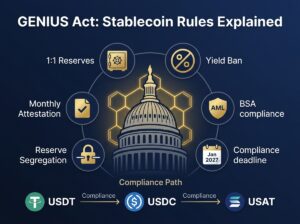
The GENIUS Act creates a new legal category called a Permitted Payment Stablecoin Issuer (PPSI). To qualify, an issuer must meet six requirements.
Full 1:1 reserves. Every dollar of stablecoin in circulation must be backed by at least one dollar of high-quality liquid assets — including U.S. Treasuries, cash, overnight repos, and certain bank deposits. No more vague claims. No more mystery backing.
No rehypothecation. Reserve assets cannot be lent out, pledged as collateral, or reused. If a stablecoin issuer holds $10 billion in Treasuries, those Treasuries sit untouched in segregated accounts.
Monthly attestations. Issuers must publish monthly reports from independent accounting firms confirming the reserves match the supply. Circle already publishes these through Deloitte. Tether’s new USAT token had its first Deloitte-attested report in March 2026, showing $17.6 million in reserves backing 17.5 million USAT tokens.
Annual audits. On top of monthly attestations, issuers must undergo a full annual audit — a significantly higher standard than the quarterly snapshots Tether used to provide for USDT.
Reserve segregation. Reserves must be held in separate accounts from the issuer’s operating funds. If the company goes bankrupt, user funds are protected because reserves cannot be seized by general creditors.
AML/CFT compliance. The law classifies stablecoin issuers as financial institutions under the Bank Secrecy Act (BSA). They must maintain anti-money-laundering programs, conduct know-your-customer checks, and comply with sanctions — the same obligations as traditional banks.
The Implementation Timeline
The law is signed, but the detailed rules are still being written. Here is where things stand.
March 11, 2026: The OCC published its proposed rulemaking, a 275-page document laying out capital, liquidity, and risk management standards for federally chartered stablecoin issuers. The comment period closed on May 1, 2026.
April 7, 2026: The FDIC published its own proposed rule for state-chartered banks issuing stablecoins under the GENIUS framework. Comments are due by June 9, 2026.
April 2026: FinCEN and OFAC jointly proposed AML and sanctions rules specifically for stablecoin issuers, adding a compliance layer on top of the OCC and FDIC frameworks.
Effective date: The GENIUS Act takes effect on the earlier of January 18, 2027 (18 months after enactment) or 120 days after primary regulators finalize their rules. If the OCC and FDIC finalize by September 2026, the effective date could arrive as early as Q4 2026.
This means stablecoin issuers have roughly 8–12 months to reach full compliance.
The Yield Ban Debate: Why It Matters to You
One of the most controversial provisions is Section 4(a)(3), which prohibits stablecoin issuers from paying interest directly to holders. The intent is to keep stablecoins functioning as payment instruments — like digital cash — rather than investment products that compete with bank deposits.
However, third-party rewards are not explicitly banned. Coinbase currently offers approximately 4.1% rewards on USDC holdings. PayPal offers rewards on PYUSD. The GENIUS Act bans the issuer (Circle, Tether) from paying yield, but a distributor or exchange can still offer rewards from its own revenue.
The White House Council of Economic Advisers (CEA) published a 20-page report in April 2026 analyzing the impact. Their findings: a complete yield ban would increase total U.S. bank lending by only $2.1 billion — or 0.02% — while costing consumers $800 million in lost benefits. The cost-benefit ratio is 6.6 to 1 against the ban.
Banks, particularly community banks through the ICBA, argue that stablecoin rewards could siphon $1.3 trillion in deposits and $850 billion in loans. The CEA found this claim overstated, citing Charles River Associates research showing no statistically significant correlation between USDC growth and community-bank deposit flows.
This week, the debate evolved further. On May 2, the CLARITY Act — a separate market-structure bill — released updated text that preserves stablecoin rewards tied to usage-driven activity (like trading and transactions) while banning passive deposit-like yield. Circle stock surged 19.9% on the news. A markup could come as early as the week of May 11.
For traders, the practical takeaway is this: you can likely keep earning rewards on USDC through exchanges, but the legal structure underlying those rewards is shifting from gray zone to regulated framework.
How Major Stablecoins Are Responding
Tether (USDT – $189.5B market cap): Tether launched USAT, a brand-new federally regulated stablecoin issued through Anchorage Digital Bank, specifically designed for the U.S. market. USAT is purpose-built for GENIUS Act compliance. Meanwhile, USDT continues operating globally and is “progressing toward” compliance — but remains primarily an offshore product. Tether is the 17th-largest holder of U.S. Treasuries globally, ahead of Germany.
Circle (USDC – $78.8B market cap): Circle is the best-positioned issuer. USDC is already fully reserved with monthly Deloitte attestations, reserves managed by BlackRock, and custodied at Bank of New York Mellon. Circle received a conditional national trust bank charter from the OCC in December 2025 and has a dedicated GENIUS Act compliance page. USDC is now attested by Deloitte across 20+ jurisdictions.
PayPal (PYUSD – ~$800M market cap): Smaller but significant. PayPal already offers rewards on PYUSD and is adjusting its product for the new usage-based rewards framework.
Bank-issued stablecoins: JPMorgan offers tokenized deposits to institutional clients. Bank of New York Mellon offers tokenized deposits for collateral management. Smaller banks are working through consortia to issue USD stablecoins for cross-border remittances.
What This Means for Your Trading
Here are five practical changes to watch.
USDC is the safest stablecoin for U.S.-based traders. With Circle holding an OCC charter, Deloitte attestations, BlackRock reserve management, and full GENIUS Act alignment, USDC carries the lowest regulatory risk. If you trade on Tapbit or any other exchange, holding at least part of your stablecoins in USDC is a prudent move.
USDT may face U.S. exchange delistings. If Tether cannot demonstrate comparable GENIUS Act compliance for USDT by Q4 2026, U.S.-facing platforms may restrict or delist it. Tether’s strategy appears to be keeping USDT for global markets while pushing USAT for U.S. users.
Reward programs will restructure. The CLARITY Act compromise means exchanges can still offer activity-based rewards, but the days of passive “deposit your stablecoins and earn 8%” are numbered. Understand the difference between usage rewards and yield before choosing where to park your funds.
Remittance costs could drop dramatically. The Brookings Institution estimates that a $200 cross-border remittance, which currently costs over 6% in fees through traditional channels, could drop to pennies using regulated stablecoins settled on blockchain rails.
New stablecoin options are coming. Bank-issued stablecoins offer deposit insurance protection that crypto-native stablecoins lack. As more banks enter the market, you will have choices between the DeFi flexibility of USDC and the institutional protections of bank tokens.
Your Action Steps
Open your exchange account and check which stablecoins you currently hold. If everything is in USDT, consider diversifying at least 30–50% into USDC before Q4 2026 compliance deadlines hit.
Bookmark the OCC GENIUS Act bulletin and the FDIC proposal page to follow the final rulemaking timeline.
If you use a trading journal, add a column for stablecoin allocation to track which tokens you hold and why.
Review our stablecoin guide if you need a refresher on how stablecoins work, or our CLARITY Act explainer for the broader market-structure bill.
Quick Summary
The GENIUS Act (July 2025) created the first U.S. federal stablecoin law, requiring 1:1 reserves, monthly attestations, annual audits, reserve segregation, and full AML compliance. The OCC, FDIC, and FinCEN are all writing final rules expected by Q3–Q4 2026, with the law effective by January 18, 2027 at the latest. The yield ban affects issuers but not exchanges — rewards through third parties survive under the CLARITY Act compromise. USDC is the most compliance-ready stablecoin. USDT’s future in U.S. markets depends on USAT adoption. For traders, the message is simple: understand which stablecoins are regulated, diversify your holdings, and stay ahead of the deadlines.
Start trading with regulated stablecoins on Tapbit — sign up takes under 2 minutes.