Bitcoin swings 5% in a day. Ethereum drops 10% in a week. But there is one category of crypto that is designed to never move: stablecoins.
The stablecoin market hit a record $321 billion in April 2026, up from $130 billion just two years ago. In Q1 2026 alone, stablecoins processed $28 trillion in transactions — more than the entire US ACH payment network. Stablecoins now account for 75% of all crypto trading volume and 13% of total crypto market capitalization.
If you trade on any exchange — Binance, Coinbase, or Tapbit — you are already using stablecoins. The pair you trade most likely ends in /USDT or /USDC. But most beginners do not understand what backs these tokens, what risks they carry, or why banks and governments are fighting over them right now.
This article explains all of it.
비트코인은 하루에 5% 흔들립니다. 이더리움은 일주일에 10% 떨어집니다. 하지만 절대 움직이지 않도록 설계된 암호화폐 범주가 있습니다: 스테이블코인.
스테이블코인 시장은 2026년 4월 기준 사상 최고치인 3,210억 달러를 기록했으며, 불과 2년 전 1,300억 달러에서 증가했습니다. 2026년 1분기에만 스테이블코인이 28조 달러의 거래를 처리했습니다 — 미국 전체 ACH 결제 네트워크보다 많은 규모입니다. 스테이블코인은 현재 전체 암호화폐 거래량의 75%, 전체 암호화폐 시가총액의 13%를 차지합니다.
Binance, Coinbase, Tapbit 등 어떤 거래소에서 거래하든 이미 스테이블코인을 사용하고 있습니다. 거래하는 쌍은 대부분 /USDT 또는 /USDC로 끝납니다. 하지만 대부분의 초보자는 이 토큰의 뒷받침이 무엇인지, 어떤 리스크가 있는지, 은행과 정부가 왜 지금 이것을 놓고 싸우는지 이해하지 못합니다.
이 글에서 모두 설명합니다.
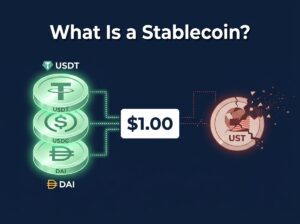
What Is a Stablecoin?
A stablecoin is a cryptocurrency designed to maintain a stable value, usually pegged 1:1 to the US dollar. When you hold 1 USDT or 1 USDC, it should always be worth exactly $1.00.
Unlike Bitcoin (which has no fixed price target) or Ethereum (which fluctuates with network demand), stablecoins exist to be boring. Their job is to hold their value perfectly while giving you the speed and flexibility of crypto.
Think of it this way: stablecoins are the “cash” of the crypto world. When you sell Bitcoin at $78,000 because you think the price will drop, you convert it to USDT. Your $78,000 sits safely as 78,000 USDT while you wait for a better entry point. Without stablecoins, you would have to send money back to your bank account every time you wanted to exit a trade — a process that takes days and costs fees.
스테이블코인은 안정적인 가치를 유지하도록 설계된 암호화폐로, 보통 미국 달러에 1:1로 고정됩니다. 1 USDT 또는 1 USDC를 보유하면 항상 정확히 $1.00의 가치를 가져야 합니다.
비트코인(고정 가격 목표 없음)이나 이더리움(네트워크 수요에 따라 변동)과 달리, 스테이블코인은 지루하게 존재합니다. 가치를 완벽히 유지하면서 암호화폐의 속도와 유연성을 제공하는 것이 목적입니다.
이렇게 생각하세요: 스테이블코인은 암호화폐 세계의 “현금”입니다. 가격 하락을 예상하고 비트코인을 $78,000에 매도하면 USDT로 전환합니다. 더 좋은 진입 시점을 기다리는 동안 $78,000가 78,000 USDT로 안전하게 보관됩니다. 스테이블코인이 없으면 거래에서 빠져나올 때마다 은행 계좌로 돈을 보내야 합니다 — 며칠 걸리고 수수료가 드는 과정입니다.
Three Types of Stablecoins
Not all stablecoins work the same way. The backing mechanism determines how safe your dollar actually is.
Type 1: Fiat-Collateralized (Backed by Real Dollars)
For every token issued, the company holds $1 (or equivalent) in reserve — typically US Treasury bills, bank deposits, or money market funds. This is the most common and most trusted type.
Examples: USDT (Tether, $184B market cap), USDC (Circle, $78B), USD1 (World Liberty Financial, $4.65B).
Type 2: Crypto-Collateralized (Backed by Other Crypto)
The stablecoin is backed by cryptocurrency locked in smart contracts. Because crypto is volatile, these systems require over-collateralization — typically $1.50 or more in crypto for every $1 of stablecoin issued.
Example: DAI (MakerDAO), which uses ETH and other assets as collateral locked in smart contracts.
Type 3: Algorithmic (Backed by Math, Not Money)
No reserve at all. An algorithm automatically adjusts supply to maintain the peg. When the price goes above $1, the algorithm creates more tokens. When it drops below $1, it burns tokens.
This type carries the highest risk. The most infamous example is TerraUSD (UST), which collapsed in May 2022, wiping out $50 billion in three days. When selling pressure overwhelmed the algorithm, the peg broke and never recovered. The lesson: if a stablecoin promises high yields without clear reserves, treat it with extreme caution.
모든 스테이블코인이 같은 방식으로 작동하지 않습니다. 담보 메커니즘이 달러의 실제 안전성을 결정합니다.
유형 1: 법정화폐 담보 (실제 달러 뒷받침): 발행된 각 토큰에 대해 회사가 미국 국채, 은행 예금, 머니마켓 펀드 등의 형태로 $1(또는 동등물)을 준비금으로 보유합니다. 가장 일반적이고 신뢰받는 유형입니다. 예: USDT(Tether, 시총 1,840억 달러), USDC(Circle, 780억 달러), USD1(World Liberty Financial, 46.5억 달러).
유형 2: 암호화폐 담보 (다른 암호화폐 뒷받침): 스마트 컨트랙트에 잠긴 암호화폐로 뒷받침됩니다. 암호화폐가 변동성이 있으므로 과담보가 필요합니다 — 보통 스테이블코인 $1당 $1.50 이상의 암호화폐. 예: DAI(MakerDAO).
유형 3: 알고리즘 (돈이 아닌 수학으로 뒷받침): 준비금이 전혀 없습니다. 알고리즘이 자동으로 공급을 조정하여 페그를 유지합니다. 가장 악명 높은 예는 TerraUSD(UST)로, 2022년 5월 3일 만에 500억 달러를 소멸시키며 붕괴했습니다. 교훈: 명확한 준비금 없이 높은 수익을 약속하는 스테이블코인은 극도로 주의하세요.
USDT vs USDC: The Two Giants
These two tokens together control over 80% of the stablecoin market. Understanding their differences helps you choose which to hold.
| Factor | USDT (Tether) | USDC (Circle) |
|---|---|---|
| Market Cap (Apr 2026) | $184 billion | $78 billion |
| Market Share | ~58% | ~24% |
| Issuer | Tether Limited (British Virgin Islands) | Circle (US-based, regulated) |
| Reserve Transparency | Quarterly attestation reports | Monthly third-party audits by Deloitte |
| Reserve Composition | US Treasuries, secured loans, Bitcoin, gold | 80%+ US Treasuries, bank deposits |
| Regulation | Not fully US-regulated; faces MiCA pressure in Europe | US-regulated; licensed in all 50 states |
| Q1 2026 Supply Change | -$3 billion (first decline since 2022) | +$2 billion |
| On-Chain Volume | $1.3T adjusted (Q1 YTD by Mar 2026) | $2.2T adjusted (overtook USDT for first time) |
| Primary Use | Retail trading, emerging market payments | Institutional settlement, B2B payments |
| Key Chains | Tron (peer-to-peer), BNB Chain (retail) | Ethereum (institutional), Base, Solana |
A notable shift happened in Q1 2026: USDC overtook USDT in organic on-chain volume for the first time since 2019 — $2.2 trillion vs $1.3 trillion year-to-date by March, confirmed by Mizuho Securities. Meanwhile, USDT’s supply dropped by $3 billion, its first quarterly decline since 2022. This reflects a rotation from offshore, less-regulated assets toward US-regulated options as the GENIUS Act takes effect.
For beginners: both are generally safe for trading. USDC offers better transparency and regulatory backing. USDT has more trading pairs and deeper liquidity on most exchanges.
이 두 토큰이 스테이블코인 시장의 80% 이상을 장악합니다.
| 요소 | USDT (Tether) | USDC (Circle) |
|---|---|---|
| 시가총액 (2026년 4월) | 1,840억 달러 | 780억 달러 |
| 시장 점유율 | ~58% | ~24% |
| 발행사 | Tether Limited (영국령 버진아일랜드) | Circle (미국 기반, 규제됨) |
| 준비금 투명성 | 분기별 증명 보고서 | 월간 제3자 감사 (Deloitte) |
| Q1 2026 공급 변화 | -30억 달러 (2022년 이후 첫 감소) | +20억 달러 |
| 온체인 거래량 | 1.3조 달러 조정치 | 2.2조 달러 (사상 처음 USDT 추월) |
| 주요 용도 | 소매 거래, 신흥시장 결제 | 기관 정산, B2B 결제 |
2026년 1분기에 주목할 만한 변화: USDC가 2019년 이후 처음으로 유기적 온체인 거래량에서 USDT를 추월했습니다. Mizuho Securities 확인. 한편 USDT 공급은 30억 달러 감소하여 2022년 이후 첫 분기 하락을 기록했습니다. 이는 GENIUS Act 시행에 따라 역외, 규제가 덜한 자산에서 미국 규제 옵션으로의 전환을 반영합니다.
초보자에게: 둘 다 거래에는 일반적으로 안전합니다. USDC는 더 나은 투명성과 규제 뒷받침을 제공합니다. USDT는 대부분의 거래소에서 더 많은 거래 쌍과 더 깊은 유동성을 가지고 있습니다.
What Is the GENIUS Act and Why It Changes Stablecoins
The GENIUS Act (Guiding and Establishing National Innovation for US Stablecoins) was signed into law in July 2025. It is the first federal law specifically designed to regulate stablecoins in the United States.
What it requires: stablecoin issuers must hold 100% reserves in safe assets (primarily US Treasuries), submit to regular audits, implement anti-money laundering (AML) and know-your-customer (KYC) programs, and guarantee users can redeem their tokens for $1.00 at any time.
As of April 2026, the law is actively being implemented. The OCC proposed licensing rules on February 25, 2026. Treasury proposed anti-illicit-finance rules on April 8, 2026. FinCEN and OFAC proposed AML/sanctions rules for issuers. Comment periods remain open, with final rules expected by late 2026 or early 2027.
The most heated controversy is over stablecoin yield. Some platforms let you earn interest on your USDT or USDC — similar to a savings account. Banks argue this competes unfairly with traditional deposits. A White House study found that banning stablecoin yield would increase bank lending by just $2.1 billion (0.02%) while costing consumers $800 million in lost returns. As of April 2026, the compromise allows yield on DeFi-based holdings but restricts yield on centralized exchange accounts that “look like deposit products.”
This directly connects to the CLARITY Act we covered yesterday — the stablecoin yield fight is the main reason the CLARITY Act is stalled in the Senate.
GENIUS Act(미국 스테이블코인을 위한 국가 혁신 지도 및 확립법)은 2025년 7월 법으로 서명되었습니다. 미국에서 스테이블코인을 규제하기 위해 특별히 설계된 최초의 연방법입니다.
요구사항: 스테이블코인 발행사는 안전 자산(주로 미국 국채)에 100% 준비금 보유, 정기 감사 수행, AML/KYC 프로그램 시행, 사용자가 언제든 토큰을 $1.00에 상환할 수 있도록 보장해야 합니다.
가장 뜨거운 논쟁은 스테이블코인 수익입니다. 일부 플랫폼에서 USDT나 USDC에 대해 이자를 받을 수 있는데, 은행들은 이것이 전통 예금과 불공정하게 경쟁한다고 주장합니다. 백악관 연구에 따르면 스테이블코인 수익을 금지하면 은행 대출이 21억 달러(0.02%)만 증가하는 반면 소비자에게 8억 달러의 수익 손실을 초래합니다.
이것은 어제 다룬 CLARITY Act와 직접 연결됩니다 — 스테이블코인 수익 분쟁이 CLARITY Act가 상원에서 정체된 주요 이유입니다.
Five Ways You Already Use Stablecoins (Even If You Didn’t Know)
1. Trading pairs. Every time you trade BTC/USDT or ETH/USDC, stablecoins are the “other side” of your trade. Without them, you would need separate fiat currency markets for every crypto asset.
2. Parking profits. Sold Bitcoin at $78,000? Your funds sit in USDT until you re-enter. This is why stablecoins captured 75% of all crypto trading volume in Q1 2026.
3. Cross-border payments. Sending $1,000 from the US to the Philippines through a bank costs $30–$50 and takes 3–5 days. Sending 1,000 USDC on Solana costs under $0.01 and arrives in seconds. Forbes reports stablecoins are increasingly used in cross-border B2B payments, with companies like Stripe and Visa settling in USDC.
4. DeFi yields. Depositing stablecoins into DeFi protocols like Aave or Compound earns interest. In Q1 2026, yield-bearing stablecoins grew 22%, adding $4.3 billion in market cap — more than half of all new stablecoin supply.
5. Emerging market dollar access. In countries with currency controls, stablecoins are the easiest way to hold US dollars. Orbital Research reports stablecoin premiums of 97% in Algeria, 71% in Bolivia, and 41% in Venezuela — meaning people pay significantly more than $1 for a $1 stablecoin because dollar access is that valuable.
1. 거래 쌍. BTC/USDT나 ETH/USDC를 거래할 때마다 스테이블코인이 거래의 “반대편”입니다.
2. 이익 주차. 비트코인을 $78,000에 매도했나요? 다시 진입할 때까지 자금이 USDT에 보관됩니다. 스테이블코인이 2026년 1분기 전체 암호화폐 거래량의 75%를 차지한 이유입니다.
3. 국경 간 결제. 미국에서 필리핀으로 $1,000을 은행으로 보내면 $30~$50이 들고 3~5일 걸립니다. Solana에서 1,000 USDC를 보내면 $0.01 미만이며 몇 초 만에 도착합니다.
4. DeFi 수익. Aave나 Compound 같은 DeFi 프로토콜에 스테이블코인을 예치하면 이자를 받습니다. 2026년 1분기, 수익 창출형 스테이블코인은 22% 성장하여 43억 달러의 시가총액을 추가했습니다.
5. 신흥시장 달러 접근. 통화 통제가 있는 국가에서 스테이블코인은 미국 달러를 보유하는 가장 쉬운 방법입니다. 알제리에서 97%, 볼리비아에서 71%, 베네수엘라에서 41%의 프리미엄을 지불합니다.
Stablecoin Risks Every Beginner Must Know
Stablecoins are designed to be stable, but “designed to be” and “always are” are not the same thing.
1. Depegging risk. A stablecoin can temporarily lose its $1 peg if there is a rush of redemptions, reserve concerns, or market panic. In February 2026, USD1 briefly depegged to $0.994. In March 2023, USDC dropped to $0.87 when Silicon Valley Bank collapsed (Circle held $3.3 billion there). Both recovered, but the hours in between were terrifying for anyone holding large positions.
2. Reserve risk. Tether has faced years of questions about whether it truly holds $1 for every USDT in circulation. As of 2026, Tether publishes quarterly attestation reports showing US Treasuries as its primary reserve, but it has never undergone a full independent audit. The GENIUS Act may force more transparency.
3. Regulatory risk. In Europe, MiCA regulations forced Tether to withdraw USDT from several compliant exchanges. In the US, the GENIUS Act imposes new requirements that some issuers may struggle to meet. Regulatory changes can affect where and how you can use stablecoins.
4. Smart contract risk (for DeFi users). If you deposit stablecoins in a DeFi protocol, a bug in the smart contract could result in loss of funds. This does not affect holding stablecoins in an exchange wallet, but it is a real risk for anyone using DeFi lending or liquidity pools.
5. Concentration risk. USDT’s supply is heavily concentrated: 74% of USD1 sits on Binance; 70%+ of USDT supply sits in “unknown wallets” attributed to exchange cold storage. If a major exchange fails — as FTX did — the impact on stablecoins could be severe.
스테이블코인은 안정적이도록 설계되어 있지만, “설계된” 것과 “항상 그런” 것은 다릅니다.
1. 디페깅 리스크. 상환 쇄도, 준비금 우려, 시장 패닉 시 $1 페그를 일시적으로 잃을 수 있습니다. 2026년 2월 USD1은 잠시 $0.994로 디페깅되었습니다. 2023년 3월 USDC는 실리콘밸리 은행 붕괴 시 $0.87까지 하락했습니다(Circle이 33억 달러 보유). 둘 다 회복되었지만, 대규모 포지션을 보유한 사람에게 그 시간은 공포였습니다.
2. 준비금 리스크. Tether는 모든 USDT에 대해 $1을 보유하는지 여부에 대한 의문에 수년간 직면했습니다. 전체 독립 감사를 받은 적이 없습니다.
3. 규제 리스크. 유럽에서 MiCA 규정은 Tether가 여러 준수 거래소에서 USDT를 철수하게 했습니다.
4. 스마트 컨트랙트 리스크. DeFi 프로토콜에 스테이블코인을 예치하면 스마트 컨트랙트 버그로 자금 손실이 발생할 수 있습니다.
5. 집중 리스크. USDT 공급이 거래소 콜드 스토리지에 크게 집중되어 있습니다. 대형 거래소 파산 시 영향이 심각할 수 있습니다.
The Terra Collapse: A Lesson Every Beginner Should Remember
In May 2022, TerraUSD (UST) — an algorithmic stablecoin — collapsed from $1 to near $0 in three days. $50 billion in value disappeared. Its sister token LUNA fell from $80 to $0.0001. The algorithm that was supposed to maintain the peg failed catastrophically when selling pressure exceeded its capacity.
The lesson is simple: never trust a stablecoin that does not hold real-dollar reserves. Algorithmic stablecoins remain the riskiest category. If a project promises 20% APY on a stablecoin and you cannot find clear information about what backs it, stay away. Check the issuer’s website for reserve reports, attestations, or audits before holding large amounts.
2022년 5월, 알고리즘 스테이블코인 TerraUSD(UST)가 3일 만에 $1에서 거의 $0으로 붕괴했습니다. 500억 달러의 가치가 사라졌습니다. 자매 토큰 LUNA는 $80에서 $0.0001로 폭락했습니다.
교훈은 간단합니다: 실제 달러 준비금을 보유하지 않는 스테이블코인은 절대 신뢰하지 마세요. 프로젝트가 스테이블코인에 20% APY를 약속하면서 뒷받침이 무엇인지 명확한 정보를 찾을 수 없다면 피하세요.
A Beginner’s Stablecoin Checklist
Before holding or using any stablecoin, ask these five questions:
- What type is it? Fiat-collateralized (safest), crypto-collateralized (moderate risk), or algorithmic (highest risk)?
- Who is the issuer? US-regulated (Circle/USDC) or offshore (Tether/USDT)? Is there a named, audited company behind it?
- Can I see the reserves? Monthly audits (USDC) > quarterly attestations (USDT) > no transparency (avoid).
- Has it ever depegged? A brief depegging during extreme market stress is normal. A prolonged depegging or collapse means the mechanism is broken.
- Am I using it for trading or for savings? For short-term trading, USDT’s deeper liquidity is fine. For longer-term holding, USDC’s better regulatory standing offers more peace of mind.
스테이블코인을 보유하거나 사용하기 전에 다섯 가지 질문을 하세요:
- 어떤 유형인가? 법정화폐 담보(가장 안전), 암호화폐 담보(중간 리스크), 알고리즘(가장 높은 리스크)?
- 발행사가 누구인가? 미국 규제(Circle/USDC) 또는 역외(Tether/USDT)?
- 준비금을 볼 수 있는가? 월간 감사(USDC) > 분기 증명(USDT) > 투명성 없음(피하세요).
- 디페깅된 적이 있는가? 극심한 시장 스트레스 중 짧은 디페깅은 정상. 장기 디페깅이나 붕괴는 메커니즘이 깨진 것입니다.
- 거래용인가 저축용인가? 단기 거래에는 USDT의 깊은 유동성이 괜찮습니다. 장기 보유에는 USDC의 규제 입지가 더 안심됩니다.
Quick Summary
Stablecoins are cryptocurrencies pegged to $1, backed by reserves (fiat-collateralized), other crypto (crypto-collateralized), or algorithms (highest risk). The market reached a record $321 billion in April 2026. USDT dominates with $184B (58% share) but is shrinking; USDC is growing at $78B (24%) and overtook USDT in on-chain volume. Stablecoins process $28 trillion per quarter — more than the US ACH network. The GENIUS Act (signed July 2025) requires 100% reserves, audits, and AML/KYC compliance. The stablecoin yield fight between banks and crypto companies is blocking the CLARITY Act. Terra’s $50B collapse in 2022 proves algorithmic stablecoins are dangerous. For beginners: use USDT or USDC, check reserves, and never trust high-yield stablecoins without clear backing.
스테이블코인은 $1에 고정된 암호화폐로, 준비금(법정화폐 담보), 다른 암호화폐(암호화폐 담보), 또는 알고리즘(가장 높은 리스크)으로 뒷받침됩니다. 시장은 2026년 4월 사상 최고 3,210억 달러에 도달했습니다. USDT가 1,840억 달러(58%)로 지배하지만 축소 중; USDC가 780억 달러(24%)로 성장하며 온체인 거래량에서 USDT를 추월했습니다. 스테이블코인은 분기당 28조 달러를 처리합니다. GENIUS Act(2025년 7월 서명)은 100% 준비금, 감사, AML/KYC 준수를 요구합니다. Terra의 2022년 500억 달러 붕괴는 알고리즘 스테이블코인의 위험을 증명합니다. 초보자: USDT 또는 USDC를 사용하고, 준비금을 확인하고, 명확한 뒷받침 없이 고수익 스테이블코인을 절대 신뢰하지 마세요.
Practice: Open Tapbit and check your stablecoin balance. Which stablecoin are you holding — USDT or USDC? Look up its latest reserve report (Tether Transparency / Circle Transparency). Write in your trading journal why you chose that stablecoin and whether you are comfortable with its risk profile.
연습: Tapbit을 열고 스테이블코인 잔액을 확인하세요. USDT를 보유 중인가요, USDC인가요? 최신 준비금 보고서를 확인하세요. 거래 일지에 그 스테이블코인을 선택한 이유와 리스크 프로필이 편안한지 적어보세요.
Disclosure: This article contains affiliate links. We may earn a commission at no extra cost to you.