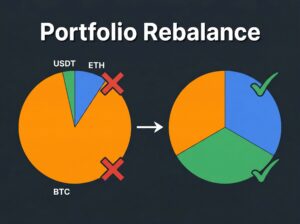
포트폴리오 리밸런싱은 자산 배분을 원래 목표 비율로 다시 맞추는 과정입니다. 예를 들어 처음에 BTC 60%, ETH 25%, 스테이블코인 15%로 설정했는데, BTC가 급등하면 비율이 70/20/10으로 변합니다. 이때 BTC를 일부 팔고 ETH와 스테이블코인을 추가해서 원래 비율로 돌리는 것이 리밸런싱입니다. Crypto Research Report에 따르면 비트코인의 역사적 최적 리밸런싱 빈도는 연간(수익률 143%)이었고, 분기별(111%), 월간(97%) 순이었습니다. 이 글에서는 리밸런싱의 개념, 왜 필요한지, 시간 기반 vs 임계값 기반 리밸런싱 방법, 실전 예시, 그리고 초보자가 언제 리밸런싱해야 하는지를 상세하게 설명합니다.
Why Your Portfolio Drifts Out of Balance
When you first set up your crypto portfolio, you choose target allocations based on your risk tolerance and strategy. A typical beginner portfolio might look like this: 50 percent Bitcoin, 30 percent Ethereum, and 20 percent stablecoins. These percentages reflect your plan — how much risk you want, how much growth exposure you need, and how much cash reserve you keep.
But the market does not care about your plan. Crypto assets move at different speeds and in different directions. Over the past month, Bitcoin rallied approximately 9 percent from $63,000 to $71,800, partly driven by the Iran ceasefire and Hormuz crypto toll news. Meanwhile, Ethereum’s dominance actually dropped from 14.6 to 10.8 percent, meaning ETH underperformed BTC significantly.
If you started with $10,000 allocated as $5,000 BTC, $3,000 ETH, and $2,000 USDT, after one month your portfolio might look like $5,450 BTC (54.1%), $3,060 ETH (30.4%), and $2,000 USDT (15.5%). Your Bitcoin allocation has drifted above your 50 percent target, your stablecoin buffer has shrunk as a percentage, and your overall risk profile has shifted without you making a single trade.
This drift is why rebalancing exists.
왜 포트폴리오가 균형에서 벗어나는가
처음 크립토 포트폴리오를 설정할 때, 리스크 허용도와 전략에 따라 목표 배분을 선택합니다. 일반적인 초보자 포트폴리오는 비트코인 50%, 이더리움 30%, 스테이블코인 20%일 수 있습니다. 이 비율은 계획을 반영합니다 — 원하는 리스크 수준, 성장 노출도, 현금 비축량.
하지만 시장은 당신의 계획을 신경 쓰지 않습니다. 크립토 자산은 다른 속도와 다른 방향으로 움직입니다. 지난 한 달간 비트코인은 이란 휴전과 호르무즈 크립토 통행료 뉴스에 힘입어 $63,000에서 $71,800으로 약 9% 상승했습니다. 반면 이더리움 도미넌스는 14.6%에서 10.8%로 하락했는데, ETH가 BTC 대비 크게 저조했다는 뜻입니다.
$10,000을 BTC $5,000, ETH $3,000, USDT $2,000으로 시작했다면, 한 달 후 포트폴리오는 BTC $5,450(54.1%), ETH $3,060(30.4%), USDT $2,000(15.5%)이 될 수 있습니다. 비트코인 배분이 50% 목표를 넘었고, 스테이블코인 버퍼는 비율적으로 줄었으며, 단 한 번의 거래도 하지 않았는데 전체 리스크 프로필이 변했습니다.
이 드리프트가 리밸런싱이 존재하는 이유입니다.
What Rebalancing Actually Means
Rebalancing is the process of selling assets that have grown beyond their target allocation and buying assets that have fallen below their target, bringing your portfolio back to its original percentages.
Using the example above, rebalancing would mean selling approximately $410 worth of Bitcoin (bringing it back to 50 percent), buying approximately $60 worth of Ethereum (restoring it to 30 percent), and adding approximately $350 to your stablecoin position (restoring it to 20 percent).
The result is that you lock in some of Bitcoin’s gains, reinforce your weaker position in Ethereum, and rebuild your cash buffer — all without changing your overall investment thesis. You are not predicting which asset will perform better next month. You are systematically maintaining the risk profile you chose when you were thinking clearly, not when emotions were running high.
This is the opposite of what most beginners do. Most beginners let winners run unchecked, add more to winning positions out of greed, and ignore losing positions out of hope. Rebalancing forces disciplined behavior.
리밸런싱이 실제로 의미하는 것
리밸런싱은 목표 배분을 초과해 성장한 자산을 팔고, 목표 아래로 떨어진 자산을 사서 포트폴리오를 원래 비율로 되돌리는 과정입니다.
위 예시에서 리밸런싱은 비트코인을 약 $410 매도(50%로 복원)하고, 이더리움을 약 $60 추가 매수(30%로 복원)하고, 스테이블코인 포지션에 약 $350을 추가(20%로 복원)하는 것입니다.
결과적으로 비트코인 수익의 일부를 확정하고, 이더리움의 약한 포지션을 강화하며, 현금 버퍼를 재구축합니다 — 전체 투자 논리를 바꾸지 않으면서. 다음 달 어떤 자산이 더 잘 될지 예측하는 것이 아닙니다. 감정이 고조된 때가 아니라 명확하게 생각할 때 선택한 리스크 프로필을 체계적으로 유지하는 것입니다.
이것은 대부분의 초보자가 하는 것과 반대입니다. 대부분의 초보자는 승자를 통제 없이 방치하고, 탐욕으로 승리 포지션에 더 추가하며, 희망으로 손실 포지션을 무시합니다. 리밸런싱은 규율 있는 행동을 강제합니다.
Two Rebalancing Methods — Calendar vs Threshold
There are two main approaches to deciding when to rebalance.
The calendar-based method means you rebalance on a fixed schedule regardless of what the market has done. Common intervals are monthly, quarterly, or annually. You pick a date — say the first day of each quarter — and rebalance your portfolio back to target allocations on that day no matter what.
According to Crypto Research Report, the historically optimal rebalancing frequency for Bitcoin has been yearly, which produced a 143 percent return, followed by quarterly at 111 percent, and monthly at 97 percent. This suggests that rebalancing too frequently can actually hurt returns by cutting winning positions too early, while rebalancing too rarely allows excessive drift.
The threshold-based method means you rebalance whenever any asset drifts beyond a certain percentage from its target. For example, if your target Bitcoin allocation is 50 percent and you set a 5 percent threshold, you rebalance whenever Bitcoin’s actual allocation exceeds 55 percent or falls below 45 percent. This method responds to market conditions rather than the calendar.
For beginners, quarterly calendar-based rebalancing is the simplest and most effective starting point. It removes emotion from the process, creates a regular habit, and aligns with the data showing strong historical performance.
두 가지 리밸런싱 방법 — 달력 기반 vs 임계값 기반
리밸런싱 시점을 결정하는 두 가지 주요 접근법이 있습니다.
달력 기반 방법은 시장 상황에 관계없이 고정된 일정에 따라 리밸런싱하는 것입니다. 일반적인 간격은 월간, 분기별, 연간입니다. 날짜를 정하고 — 예를 들어 매 분기 첫째 날 — 그날 시장 상황에 상관없이 포트폴리오를 목표 배분으로 리밸런싱합니다.
Crypto Research Report에 따르면 비트코인의 역사적 최적 리밸런싱 빈도는 연간(143% 수익률)이었고, 분기별(111%), 월간(97%) 순이었습니다. 이는 너무 자주 리밸런싱하면 승리 포지션을 너무 일찍 줄여 수익에 오히려 해가 될 수 있고, 너무 드물게 하면 과도한 드리프트를 허용한다는 것을 시사합니다.
임계값 기반 방법은 어떤 자산이 목표에서 특정 퍼센티지 이상 벗어날 때마다 리밸런싱하는 것입니다. 예를 들어 비트코인 목표 배분이 50%이고 5% 임계값을 설정했다면, 비트코인 실제 배분이 55%를 넘거나 45% 아래로 떨어질 때마다 리밸런싱합니다. 이 방법은 달력이 아닌 시장 상황에 반응합니다.
초보자에게는 분기별 달력 기반 리밸런싱이 가장 간단하고 효과적인 출발점입니다. 과정에서 감정을 제거하고, 규칙적인 습관을 만들며, 강한 역사적 성과를 보여주는 데이터와 일치합니다.
Step-by-Step Rebalancing Example
Let us walk through a complete rebalancing scenario with real numbers.
You start with $10,000 on January 1 with these target allocations: BTC 50 percent ($5,000), ETH 30 percent ($3,000), USDT 20 percent ($2,000). You set a quarterly rebalancing schedule, so your next rebalance date is April 1.
By April 1, after the Iran conflict volatility and ceasefire rally, your portfolio values have changed. BTC grew 14 percent to $5,700 (now 53.8 percent of portfolio). ETH grew 3 percent to $3,090 (now 29.2 percent). USDT stayed at $2,000 (now 18.9 percent, since you did not add to it but total portfolio grew). Total portfolio value is now $10,790.
To rebalance, calculate what each asset should be at target percentages of the new total. BTC target: 50 percent of $10,790 = $5,395. ETH target: 30 percent of $10,790 = $3,237. USDT target: 20 percent of $10,790 = $2,158.
Actions needed: sell $305 worth of BTC ($5,700 minus $5,395). Buy $147 worth of ETH ($3,237 minus $3,090). Add $158 to USDT ($2,158 minus $2,000). The $305 from selling BTC covers the $147 ETH purchase and $158 USDT addition.
After rebalancing, your portfolio is back to 50/30/20 but now worth $10,790 instead of $10,000. You locked in BTC gains, strengthened your ETH position, and rebuilt your stablecoin reserve.
단계별 리밸런싱 예시
실제 숫자로 완전한 리밸런싱 시나리오를 살펴보겠습니다.
1월 1일 $10,000으로 시작하며 목표 배분은 BTC 50%($5,000), ETH 30%($3,000), USDT 20%($2,000)입니다. 분기별 리밸런싱 일정을 설정해서 다음 리밸런싱 날짜는 4월 1일입니다.
4월 1일까지, 이란 분쟁 변동성과 휴전 랠리를 거치며 포트폴리오 가치가 변했습니다. BTC는 14% 성장하여 $5,700(포트폴리오의 53.8%). ETH는 3% 성장하여 $3,090(29.2%). USDT는 $2,000 유지(18.9%, 추가하지 않았지만 총 포트폴리오가 성장해서). 총 포트폴리오 가치는 $10,790.
리밸런싱을 위해, 각 자산이 새 총액의 목표 비율에서 얼마여야 하는지 계산합니다. BTC 목표: $10,790의 50% = $5,395. ETH 목표: $10,790의 30% = $3,237. USDT 목표: $10,790의 20% = $2,158.
필요한 조치: BTC $305 매도($5,700 – $5,395). ETH $147 추가 매수($3,237 – $3,090). USDT에 $158 추가($2,158 – $2,000). BTC 매도 $305가 ETH 매수 $147과 USDT 추가 $158을 충당합니다.
리밸런싱 후 포트폴리오는 50/30/20으로 돌아갔지만 $10,000이 아닌 $10,790입니다. BTC 수익을 확정하고, ETH 포지션을 강화하며, 스테이블코인 비축을 재구축했습니다.
When NOT to Rebalance
Rebalancing is powerful, but there are situations where you should pause or skip it.
Do not rebalance during extreme volatility. If Bitcoin just dropped 15 percent in a day due to a geopolitical shock, rebalancing immediately would mean buying into panic. Wait for the market to stabilize before executing. The Fear and Greed Index can help — if it is below 15 (extreme fear, like the reading of 9 on April 3), wait a few days before rebalancing.
Do not rebalance too frequently. The data shows that monthly rebalancing actually underperformed quarterly and yearly rebalancing for Bitcoin. Every rebalance involves trading fees, potential tax events, and the risk of cutting winners too early. Quarterly is the sweet spot for most beginners.
Do not rebalance if the drift is tiny. If your BTC allocation is 51 percent instead of the target 50 percent, the cost and effort of rebalancing is not worth the minimal risk reduction. Most professionals use a minimum threshold of 3 to 5 percent drift before acting.
Do not rebalance into a failing asset just because your target says so. If you originally allocated 10 percent to an altcoin that has lost 80 percent of its value and shows no signs of recovery, blindly rebalancing into it is throwing good money after bad. Rebalancing assumes your original allocation thesis is still valid. If the thesis has changed, update your targets first.
리밸런싱하지 말아야 할 때
리밸런싱은 강력하지만, 멈추거나 건너뛰어야 할 상황이 있습니다.
극심한 변동성 중에는 리밸런싱하지 마세요. 지정학적 충격으로 비트코인이 하루에 15% 하락했다면, 즉시 리밸런싱하는 것은 패닉에 매수하는 것입니다. 시장이 안정될 때까지 기다리세요. 공포탐욕지수가 도움이 됩니다 — 15 아래(4월 3일의 9 같은 극단적 공포)라면 리밸런싱 전 며칠 기다리세요.
너무 자주 리밸런싱하지 마세요. 데이터에 따르면 월간 리밸런싱은 비트코인에서 분기별과 연간 리밸런싱보다 성과가 저조했습니다. 매 리밸런싱마다 거래 수수료, 잠재적 세금 이벤트, 승자를 너무 일찍 줄이는 위험이 수반됩니다. 대부분의 초보자에게 분기별이 최적입니다.
드리프트가 작으면 리밸런싱하지 마세요. BTC 배분이 목표 50% 대신 51%라면, 리밸런싱의 비용과 노력이 미미한 리스크 감소에 비해 가치가 없습니다. 대부분의 전문가는 행동 전 최소 3~5% 드리프트 임계값을 사용합니다.
목표가 그렇다는 이유만으로 실패하는 자산에 리밸런싱하지 마세요. 원래 알트코인에 10%를 배분했는데 그 코인이 가치의 80%를 잃고 회복 조짐이 없다면, 맹목적으로 리밸런싱하는 것은 좋은 돈을 나쁜 곳에 버리는 것입니다. 리밸런싱은 원래 배분 논리가 여전히 유효하다고 가정합니다. 논리가 바뀌었다면 먼저 목표를 업데이트하세요.
Combining Rebalancing With Your Existing Strategy
Rebalancing works best when combined with the tools you already know. Before rebalancing, check if the asset you are about to buy more of is in a favorable position. Is the RSI in overbought territory? If so, you might wait a few days before adding. Is volume confirming the trend direction? Is the price near a support level where buying makes more sense?
You can also combine rebalancing with dollar-cost averaging. Instead of rebalancing all at once on a single day, spread the rebalancing trades over a week. Sell a portion of the overweight asset each day and buy a portion of the underweight asset. This reduces the impact of short-term price swings on your rebalancing execution.
Keep your stablecoin allocation sacred during rebalancing. Your stablecoin reserve is your emergency fund and buying-the-dip capital. If rebalancing pushes your stablecoin percentage below 15 percent, consider adjusting other positions instead.
리밸런싱을 기존 전략과 결합하기
리밸런싱은 이미 알고 있는 도구들과 결합할 때 가장 잘 작동합니다. 리밸런싱 전에 더 살 자산이 유리한 위치에 있는지 확인하세요. RSI가 과매수 영역인가요? 그렇다면 추가 전 며칠 기다리는 것이 좋을 수 있습니다. 거래량이 추세 방향을 확인하고 있나요? 가격이 매수가 더 합리적인 지지선 근처인가요?
리밸런싱을 달러코스트 애버리징과 결합할 수도 있습니다. 하루에 한 번에 리밸런싱하는 대신, 일주일에 걸쳐 분산하세요. 과중 자산을 매일 일부 매도하고 과소 자산을 일부 매수합니다. 이렇게 하면 단기 가격 변동이 리밸런싱 실행에 미치는 영향이 줄어듭니다.
리밸런싱 중 스테이블코인 배분을 신성하게 유지하세요. 스테이블코인 비축은 비상 자금이자 하락 매수 자본입니다. 리밸런싱이 스테이블코인 비율을 15% 아래로 밀면, 다른 포지션을 대신 조정하는 것을 고려하세요.
Your Quarterly Rebalancing Checklist
Every quarter on your scheduled date, follow these steps. Step one — record the current dollar value of every asset in your portfolio. Step two — calculate each asset’s current percentage of the total portfolio. Step three — compare current percentages to your target allocations. Step four — identify which assets need to be sold (overweight) and which need to be bought (underweight). Step five — check the RSI and volume of assets you plan to buy to confirm favorable conditions. Step six — execute the trades, starting with sells and then moving to buys. Step seven — update your tracking spreadsheet from your position management system and confirm all allocations are back to target.
분기별 리밸런싱 체크리스트
예정된 날짜에 매 분기 다음 단계를 따르세요. 1단계 — 포트폴리오 내 모든 자산의 현재 달러 가치를 기록합니다. 2단계 — 각 자산의 총 포트폴리오 대비 현재 비율을 계산합니다. 3단계 — 현재 비율을 목표 배분과 비교합니다. 4단계 — 매도해야 할(과중) 자산과 매수해야 할(과소) 자산을 식별합니다. 5단계 — 매수 예정 자산의 RSI와 거래량을 확인하여 유리한 조건을 확인합니다. 6단계 — 매도부터 시작해서 매수로 이동하며 거래를 실행합니다. 7단계 — 포지션 관리 시스템의 추적 스프레드시트를 업데이트하고 모든 배분이 목표로 돌아갔는지 확인합니다.
Start Building a Balanced Portfolio Today
Rebalancing is not about predicting the future — it is about controlling risk and locking in gains systematically. Combined with dollar-cost averaging, proper stop-losses, and a disciplined position management approach, quarterly rebalancing is one of the most powerful tools a beginner can use.
Practice portfolio management on Tapbit, where you can trade BTC/USDT, ETH/USDT, and other major pairs with low fees and real-time portfolio tracking tools.
오늘부터 균형 잡힌 포트폴리오를 만드세요
리밸런싱은 미래를 예측하는 것이 아닙니다 — 리스크를 통제하고 수익을 체계적으로 확정하는 것입니다. 달러코스트 애버리징, 적절한 손절, 규율 있는 포지션 관리와 결합하면, 분기별 리밸런싱은 초보자가 사용할 수 있는 가장 강력한 도구 중 하나입니다.
Tapbit에서 포트폴리오 관리를 연습하세요. BTC/USDT, ETH/USDT 및 기타 주요 쌍을 낮은 수수료와 실시간 포트폴리오 추적 도구로 거래할 수 있습니다.
Disclosure: This article contains affiliate links. We may earn a commission at no extra cost to you.