Ethereum is about to get its biggest upgrade since The Merge — and most traders are not paying attention yet.
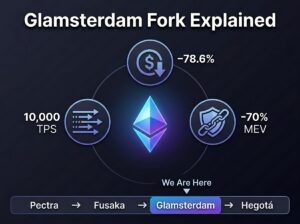
The Glamsterdam hard fork, targeted for June 2026, will triple Ethereum’s gas limit from 60 million to 200 million per block, introduce parallel transaction processing to reach approximately 10,000 TPS (up from ~1,000), cut gas fees by 78.6%, and move block building on-chain to reduce MEV extraction by up to 70%.
All of this is happening while ETH trades near $2,375 (April 23, 2026) — still down 34% from its October 2025 high of $3,600 and roughly 52% below Bitcoin’s relative performance over the same period. With 30% of ETH supply locked in staking, BlackRock filing for a staked ETH ETF, and gas fees about to collapse, the gap between what Ethereum is building and where the price sits is the kind of disconnect every trader should understand.
이더리움이 The Merge 이후 최대 규모의 업그레이드를 받으려 하고 있습니다 — 그런데 대부분의 트레이더가 아직 주목하지 않고 있습니다.
2026년 6월을 목표로 하는 Glamsterdam 하드포크는 이더리움의 가스 리밋을 블록당 6,000만에서 2억으로 3배 늘리고, 병렬 트랜잭션 처리를 도입하여 약 10,000 TPS(현재 ~1,000에서 상승)에 도달하며, 가스 비용을 78.6% 줄이고, 블록 생성을 온체인으로 이전하여 MEV 추출을 최대 70% 줄입니다.
이 모든 것이 ETH가 약 $2,375(2026년 4월 23일)에 거래되는 동안 일어나고 있습니다 — 2025년 10월 고점 $3,600에서 여전히 34% 하락. ETH 공급의 30%가 스테이킹에 잠겨 있고, BlackRock이 스테이킹 ETH ETF를 신청하고, 가스 비용이 곧 폭락할 예정인 상황에서, 이더리움이 구축하는 것과 가격이 위치한 곳의 격차는 모든 트레이더가 이해해야 할 괴리입니다.
What Is Glamsterdam?
Glamsterdam is Ethereum’s next hard fork — the third in just one year, following Pectra (May 2025) and Fusaka (December 2025). While those upgrades focused primarily on Layer 2 scaling, Glamsterdam targets the base layer itself: how fast Ethereum processes transactions, how much they cost, and who controls the order.
The upgrade is built around 8 Ethereum Improvement Proposals (EIPs) outlined by Vitalik Buterin in late February 2026. The two “headliners” are EIP-7732 (Enshrined Proposer-Builder Separation) and EIP-7928 (Block-Level Access Lists). Together with gas repricing through EIP-7904 and several smaller proposals, they represent the most comprehensive changes to Ethereum’s execution layer since proof of stake.
Target launch: H1 2026, with June as the aspirational date. Devnet testing is underway (Devnet-4 completed, transitioning to Devnet-5), followed by public testnets and dual audit phases this spring.
Glamsterdam은 이더리움의 다음 하드포크로, Pectra(2025년 5월)와 Fusaka(2025년 12월)에 이어 1년 만에 세 번째입니다. 이전 업그레이드가 주로 레이어 2 스케일링에 초점을 맞춘 반면, Glamsterdam은 기본 레이어 자체를 대상으로 합니다: 이더리움이 트랜잭션을 얼마나 빠르게 처리하는지, 비용이 얼마인지, 누가 순서를 통제하는지.
이 업그레이드는 2026년 2월 말 비탈릭 부테린이 제시한 8개의 이더리움 개선 제안(EIP)을 중심으로 구축됩니다. 두 가지 “헤드라이너”는 EIP-7732(프로토콜 내 제안자-빌더 분리)와 EIP-7928(블록 수준 접근 목록)입니다.
목표 출시: 2026년 상반기, 6월이 목표 날짜. Devnet 테스트 진행 중(Devnet-4 완료, Devnet-5 전환 중).
The Three Big Changes (Explained Simply)
Change 1: Parallel Processing — 10× Faster
The problem: Ethereum currently processes transactions one at a time, like a single checkout lane at a supermarket. If 1,000 people want to trade on Uniswap at the same time, they stand in line and wait.
The fix: EIP-7928 introduces Block-Level Access Lists (BALs). Before a block is processed, the network checks which smart contracts and accounts each transaction will touch. If two transactions interact with completely different parts of the network (for example, one is a Uniswap swap and the other is an Aave deposit), they can be processed simultaneously — like opening multiple checkout lanes.
Combined with the gas limit tripling from 60 million to 200 million, this targets approximately 10,000 TPS, up from the current ~1,000. For perspective, Solana handles roughly 3,000–5,000 TPS in real-world conditions. After Glamsterdam, Ethereum’s base layer will be competitive with Solana on speed while retaining its advantages in security and decentralization.
문제: 이더리움은 현재 트랜잭션을 하나씩 처리합니다. 슈퍼마켓의 단일 계산대처럼.
해결: EIP-7928이 블록 수준 접근 목록(BAL)을 도입합니다. 블록이 처리되기 전에 네트워크가 각 트랜잭션이 접촉할 스마트 컨트랙트와 계정을 확인합니다. 두 트랜잭션이 네트워크의 완전히 다른 부분과 상호작용하면 동시에 처리 가능합니다 — 여러 계산대를 여는 것처럼.
가스 리밋이 6,000만에서 2억으로 3배 늘어나는 것과 결합하면 약 10,000 TPS를 목표로 합니다. 참고로 솔라나는 실제 조건에서 약 3,000~5,000 TPS를 처리합니다. Glamsterdam 이후 이더리움 기본 레이어는 속도에서 솔라나와 경쟁하면서 보안과 탈중앙화의 장점을 유지합니다.
Change 2: Gas Fees Drop 78.6%
The problem: A simple Uniswap swap currently costs $3–$8 in gas. Complex DeFi operations (multi-step trades, flash loans, yield farming) can cost $20–$50. These fees pushed many users and projects to Layer 2 networks like Arbitrum, Optimism, and Base.
The fix: EIP-7904 reprices gas costs to reflect what operations actually cost on modern hardware. Many gas prices were set years ago when Ethereum nodes ran on much weaker machines. The recalibration results in a 78.6% reduction for both simple ETH transfers and complex smart contract interactions.
What this means for you: a Uniswap trade that costs $5 today could cost under $1. An Aave deposit that costs $15 could cost under $3. Complex DeFi strategies that were too expensive for small accounts become viable again.
문제: 단순 Uniswap 스왑이 현재 가스로 $3~$8 소요. 복잡한 DeFi 작업은 $20~$50.
해결: EIP-7904가 현대 하드웨어에서 실제로 드는 비용에 맞게 가스 가격을 재설정합니다. 결과적으로 78.6% 감소. 오늘 $5인 Uniswap 거래가 $1 미만이 될 수 있습니다. $15인 Aave 예치가 $3 미만이 될 수 있습니다. 소규모 계좌에 너무 비쌌던 복잡한 DeFi 전략이 다시 가능해집니다.
Change 3: MEV Reduction — Fairer Trading
The problem: MEV (Maximal Extractable Value) is the profit that block builders make by reordering, inserting, or front-running your transactions. If you submit a large swap on Uniswap, a bot can see it in the mempool, buy the token before you (front-running), drive the price up, then sell after your transaction executes — pocketing the difference. This is sometimes called a “sandwich attack.” MEV extraction cost traders an estimated $1.38 billion in mid-2024 alone.
Currently, block building happens off-chain through third-party relays like Flashbots. The top 3 builders control over 80% of all blocks, creating a centralization risk.
The fix: EIP-7732 introduces Enshrined Proposer-Builder Separation (ePBS). Block building moves from off-chain relays into the Ethereum protocol itself. Builders cryptographically seal their blocks and commit to a bid. Validators select the highest bid without seeing transaction contents. The entire process becomes transparent, auditable, and subject to Ethereum’s consensus rules.
Researchers estimate ePBS could reduce MEV extraction by up to 70%. That means fewer sandwich attacks on your DEX trades, fairer liquidation ordering on Aave/Compound, and more predictable execution for anyone using Ethereum’s base layer.
문제: MEV(최대 추출 가능 가치)는 블록 빌더가 여러분의 트랜잭션을 재정렬, 삽입, 선행 매매하여 얻는 이익입니다. Uniswap에서 대량 스왑을 제출하면 봇이 앞서 매수하고(프론트러닝), 가격을 올린 후 여러분의 트랜잭션 실행 후 매도합니다. 이를 “샌드위치 공격”이라 합니다. 2024년 중반에만 약 13.8억 달러 추출.
현재 블록 생성이 Flashbots 같은 제3자 릴레이를 통해 오프체인에서 발생. 상위 3개 빌더가 전체 블록의 80% 이상 통제.
해결: EIP-7732가 프로토콜 내 제안자-빌더 분리(ePBS)를 도입. 블록 생성이 오프체인 릴레이에서 이더리움 프로토콜 자체로 이동. 빌더가 블록을 암호화하여 봉인하고 입찰에 커밋. 검증자는 트랜잭션 내용을 보지 않고 최고 입찰을 선택. 연구자들은 ePBS가 MEV 추출을 최대 70% 줄일 수 있다고 추정합니다.
Glamsterdam at a Glance
| Feature | Before Glamsterdam | After Glamsterdam | Impact |
|---|---|---|---|
| Gas Limit | 60 million/block | 200 million/block | 3.3× more capacity |
| Throughput | ~1,000 TPS | ~10,000 TPS | 10× faster |
| Gas Fees | $3–$8 per swap | <$1 per swap | 78.6% cheaper |
| Block Building | Off-chain (Flashbots relays) | On-chain (ePBS) | Transparent, auditable |
| MEV Extraction | ~$1.38B/year | Up to 70% less | Fairer for retail traders |
| Transaction Processing | Sequential (single-lane) | Parallel (multi-lane) | Multiple txns at once |
How ETH Price Has Reacted to Past Upgrades
Every major Ethereum upgrade has moved the price — but not always in the direction you would expect.
| Upgrade | Date | Pre-Fork Rally | Post-Fork Action |
|---|---|---|---|
| The Merge | Sep 2022 | +100% from Jun lows | -15% sell-the-news |
| Shapella | Apr 2023 | +35% in 60 days | +10% (defied sell-the-news) |
| Dencun | Mar 2024 | +60% in 3 months | Flat, then -20% (macro) |
| Glamsterdam | Jun 2026 (target) | ? | ? |
The pattern: ETH tends to rally 35–100% in the 60 days before a major fork. The post-fork reaction depends more on macro conditions than on the upgrade itself. The Merge saw a sell-off because the broader market was in a bear cycle. Shapella rallied because staking withdrawals removed uncertainty. Dencun’s gains evaporated due to macro headwinds.
For Glamsterdam: ETH is currently at $2,375 with the upgrade roughly 6–8 weeks away. If the historical pattern holds, a rally toward $2,800–$3,200 before the fork is plausible. But the current macro environment (oil above $90, no Fed rate cuts, BTC still 38% below its ATH) could dampen or delay any pre-fork momentum.
| 업그레이드 | 날짜 | 포크 전 랠리 | 포크 후 반응 |
|---|---|---|---|
| The Merge | 2022년 9월 | 6월 저점에서 +100% | -15% 차익실현 |
| Shapella | 2023년 4월 | 60일간 +35% | +10% (차익실현 반박) |
| Dencun | 2024년 3월 | 3개월간 +60% | 보합 후 -20% (거시) |
| Glamsterdam | 2026년 6월 (목표) | ? | ? |
패턴: ETH는 주요 포크 전 60일간 35~100% 상승하는 경향이 있습니다. 포크 후 반응은 업그레이드 자체보다 거시 조건에 더 의존합니다.
What Glamsterdam Means for Different Types of Traders
If you trade on DEXs (Uniswap, SushiSwap): Lower gas fees mean smaller trades become profitable again. A $100 swap that lost $8 to gas (8% overhead) will only lose ~$1 (1% overhead). MEV reduction means fewer sandwich attacks — your execution price will be closer to what you expected.
If you use DeFi lending (Aave, Compound): Managing positions becomes much cheaper. Rebalancing collateral, claiming rewards, or closing positions during liquidation events will cost a fraction of current fees. This is especially important during volatile moments — when fees spike today, many users cannot afford to adjust positions.
If you hold ETH long-term: More transactions at lower cost means more EIP-1559 fee burns. If on-chain activity increases significantly (which cheaper gas historically causes), the net burn rate could increase even though each transaction burns less. This strengthens ETH’s deflationary mechanics. With 30% of supply staked and BlackRock building a staked ETH ETF, the supply-demand equation tightens further.
If you primarily use Layer 2s: You will not necessarily switch back to L1. L2s will still be cheaper for many use cases. But the “L1 is too expensive” narrative weakens, and some DeFi protocols may redeploy on L1 for the higher security guarantee. This could affect L2 token prices (ARB, OP) while benefiting ETH.
DEX 거래자: 가스 비용이 낮아져 소규모 거래가 다시 수익성이 생깁니다. $100 스왑에서 가스로 $8(8% 오버헤드)이 사라지던 것이 ~$1(1%)만 됩니다. MEV 감소로 샌드위치 공격이 줄어듭니다.
DeFi 대출 사용자 (Aave, Compound): 포지션 관리가 훨씬 저렴해집니다. 담보 재조정, 보상 청구, 청산 시 포지션 마감 비용이 현재의 일부만 됩니다.
ETH 장기 보유자: 더 낮은 비용의 더 많은 트랜잭션은 더 많은 EIP-1559 수수료 소각을 의미합니다. ETH 공급의 30%가 스테이킹에 잠겨 있고 BlackRock이 스테이킹 ETH ETF를 구축 중인 상황에서 수요-공급 방정식이 더 타이트해집니다.
레이어 2 주요 사용자: 반드시 L1으로 돌아갈 필요는 없습니다. L2가 많은 사용 사례에서 여전히 더 저렴합니다. 하지만 “L1이 너무 비싸다” 내러티브가 약화됩니다.
Risks and What Could Go Wrong
1. Delay risk. The June target is aspirational. Ethereum has delayed major upgrades before (The Merge was pushed back multiple times over years). The Base engineering team has publicly warned that adding too many EIPs could push Glamsterdam beyond 2026. If delayed, expect a short-term ETH selloff as the market reprices the timeline.
2. Sell-the-news. Even if ETH rallies into the upgrade, the activation itself could trigger 10–15% profit-taking based on historical precedent. Traders who buy late in the pre-fork rally and hold through activation often give back their gains.
3. MEV does not disappear — it migrates. ePBS makes MEV more transparent but does not eliminate the economic incentive. A January 2026 academic paper found that while ePBS reduces validator-side concentration, it “significantly amplifies profit centralization among builders.” The sophistication required to build blocks under ePBS may favor large-scale builders with low-latency infrastructure.
4. Implementation complexity. ePBS and BALs together add substantial complexity to the consensus layer. Neither has been tested at mainnet scale. Edge cases and consensus failures are possible during the early period after activation.
5. Macro overrides upgrades. ETH is in a bear market. A technical upgrade cannot single-handedly reverse macro-driven drawdowns. If oil stays above $90, the Fed holds rates, and risk appetite remains weak, Glamsterdam’s benefits will show up in metrics (lower fees, more transactions) but may not immediately translate to price appreciation.
1. 지연 리스크. 6월 목표는 희망적입니다. 이더리움은 과거 주요 업그레이드를 여러 차례 연기한 바 있습니다. Base 엔지니어링 팀은 너무 많은 EIP를 추가하면 2026년을 넘길 수 있다고 공개 경고했습니다.
2. 뉴스 매도. ETH가 업그레이드 전 상승해도, 활성화 자체가 역사적 전례에 따라 10~15% 차익실현을 촉발할 수 있습니다.
3. MEV가 사라지지 않고 이동합니다. ePBS가 MEV를 더 투명하게 만들지만 경제적 인센티브를 제거하지 않습니다. 2026년 1월 학술 논문에 따르면 “빌더 간 이익 집중이 크게 증폭됩니다.”
4. 구현 복잡성. ePBS와 BAL 모두 메인넷 규모에서 테스트되지 않았습니다.
5. 거시가 업그레이드를 압도합니다. 기술 업그레이드만으로는 거시 주도 하락을 뒤집을 수 없습니다.
Key Levels to Watch for ETH
| Level | Type | Significance |
|---|---|---|
| $2,150 | Support | March 2026 low, tested twice |
| $2,375 | Current | April 24 price |
| $2,500 | Resistance | Round number + 50-day MA |
| $2,800 | Resistance | Pre-fork rally target (historical pattern) |
| $3,200 | Resistance | Fibonacci 38.2% from ATH ($3,600) to low ($1,920) |
| $3,600 | Major Resistance | October 2025 ATH |
If you are considering a position: watch for a confirmed break above $2,500 with volume confirmation. Use a stop-loss below $2,150. Check RSI — if it is above 70 near the fork date, the sell-the-news risk increases significantly.
What Comes After Glamsterdam
Ethereum has adopted a twice-per-year upgrade cadence. The next fork, Hegotá, is planned for H2 2026 and introduces Verkle Trees — a data structure change that cuts node storage requirements by approximately 90%. This would enable “stateless clients” where new nodes can validate without downloading the full blockchain history, massively lowering the barrier to running a node.
Glamsterdam handles execution (speed, cost, block building). Hegotá handles storage and state. Together, they form Ethereum’s most comprehensive year of infrastructure development since the transition from proof of work.
이더리움은 연 2회 업그레이드 주기를 채택했습니다. 다음 포크인 Hegotá는 2026년 하반기에 계획되어 있으며 Verkle Trees를 도입합니다 — 노드 스토리지 요구사항을 약 90% 줄이는 데이터 구조 변경. Glamsterdam은 실행(속도, 비용, 블록 생성)을 처리하고, Hegotá는 스토리지와 상태를 처리합니다. 함께 프루프 오브 워크에서 전환한 이후 이더리움의 가장 포괄적인 인프라 개발 연도를 형성합니다.
Quick Summary
Glamsterdam is Ethereum’s biggest upgrade since The Merge, targeting June 2026. It triples the gas limit (60M → 200M), introduces parallel processing for ~10,000 TPS (10× current), cuts gas fees 78.6%, and moves block building on-chain with ePBS (reducing MEV up to 70%). ETH currently trades at $2,375, down 34% from its October 2025 high. Historical pattern: ETH rallies 35–100% before major forks but risks sell-the-news after. Key levels: $2,150 support, $2,500 breakout, $2,800–$3,200 pre-fork rally targets. 30% of ETH supply is staked, BlackRock filing for staked ETH ETF. Risks: delay, sell-the-news, MEV migration, macro headwinds. Next upgrade Hegotá (H2 2026) addresses storage with Verkle Trees.
Practice: Open the ETH/USDT chart on Tapbit or TradingView. Mark the $2,150 support and $2,500 resistance. Set price alerts at both levels. Draw a Fibonacci retracement from the October 2025 high ($3,600) to the February 2026 low ($1,920). Note where the 23.6%, 38.2%, and 50% levels fall. Record your ETH thesis — bullish or bearish — in your trading journal with a specific plan for each scenario.
연습: Tapbit 또는 TradingView에서 ETH/USDT 차트를 여세요. $2,150 지지선과 $2,500 저항선을 표시하세요. 두 레벨에 가격 알림을 설정하세요. 2025년 10월 고점($3,600)에서 2026년 2월 저점($1,920)까지 피보나치 되돌림을 그리세요. 거래 일지에 ETH 논리 — 강세 또는 약세 — 를 각 시나리오별 구체적 계획과 함께 기록하세요.
Disclosure: This article contains affiliate links. We may earn a commission at no extra cost to you.