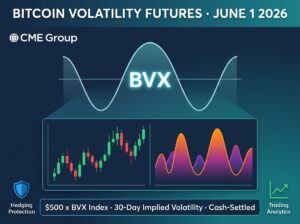
On May 5, 2026, CME Group announced that Bitcoin Volatility futures will launch on June 1, 2026 — the first regulated futures contract designed to let traders bet on or hedge against how much Bitcoin moves, rather than which direction it moves. The contracts settle to the CME CF Bitcoin Volatility Index (BVX), a 30-day forward-looking measure of implied volatility derived from live Bitcoin options order books. Each contract is sized at $500 × the BVX level. For beginners, this matters because it marks a major step in Bitcoin’s institutional maturation, comparable to the VIX’s role in traditional equity markets.
What Are Bitcoin Volatility Futures?
The Concept: Direction vs. Magnitude
Most crypto products — spot, futures, ETFs — profit when you correctly predict where Bitcoin is going. Bitcoin volatility futures are fundamentally different. They profit when you correctly predict how much Bitcoin will move, regardless of direction.
Think of it this way: if a standard Bitcoin futures contract is a bet on “Bitcoin will reach $110,000,” a volatility futures contract is a bet on “Bitcoin will swing 15% in the next 30 days — up or down.” This distinction is what makes volatility trading a separate asset class entirely.
The Traditional Finance Parallel: VIX
In traditional markets, the CBOE Volatility Index (VIX) — often called the “fear gauge” — measures expected 30-day volatility in the S&P 500. Traders have been buying and selling VIX futures since 2004 to hedge equity portfolios or speculate on market turbulence. The BVX is essentially Bitcoin’s VIX. Just as VIX futures transformed risk management for stock investors, Bitcoin volatility futures aim to do the same for crypto portfolios.
How the BVX Index Works
Real-Time Calculation
The CME CF Bitcoin Volatility Index – Real-Time (BVX) is published every second between 7:00 a.m. and 4:00 p.m. Central Time on CME trading days. It uses a standard variance swap pricing approach to calculate the 30-day constant maturity implied volatility of Bitcoin. The inputs come exclusively from CFTC-regulated CME Bitcoin and Micro Bitcoin options order books — not from unregulated offshore exchanges.
Settlement Variant (BVXS)
For actual futures settlement, CME uses the CME CF Bitcoin Volatility Index – Settlement (BVXS), published once daily at 4:00 p.m. London time. The BVXS is calculated as the average of six five-minute partitions, each partition computing a BVX VWAP weighted by order book depth. This averaging approach reduces microstructure noise and minimizes manipulation risk, making it more robust than a single snapshot.
Current BVX Reading
As of mid-May 2026, the BVXS sits around 40.50, meaning the market expects Bitcoin to move roughly 40.5% annualized over the next 30 days. For context, Bitcoin’s 30-day implied volatility fell to a two-year low of 51.28% in early April 2026, and its realized volatility has compressed toward 27%, creating a significant gap between what options traders expect and what spot markets have actually delivered.
Contract Specifications
Key Details
The Bitcoin Volatility futures contract trades under the ticker BVI on CME Globex. Each contract is sized at $500 × the CME CF Bitcoin Volatility Index. At a BVX level of 40, one contract’s notional value would be $20,000 (= $500 × 40). The contract is cash-settled to the BVXS, meaning no actual Bitcoin changes hands at expiration. These contracts are also block-eligible and support Basis Trade at Index Close (BTIC) execution.
What This Means in Practice
If you buy one BVI contract at a BVX level of 40 and volatility rises to 55 at settlement, your profit would be $7,500 (= $500 × 15 points). Conversely, if volatility drops to 32, your loss would be $4,000 (= $500 × 8 points). The dollar-per-point multiplier makes risk calculation straightforward compared to option strategies that involve multiple Greeks.
Why Bitcoin Needs Volatility Futures
The Problem They Solve
Bitcoin’s 30-day annualized volatility has historically averaged 60–80%, compared to 15–20% for the S&P 500. For institutions holding Bitcoin through spot ETFs or CME futures, this volatility is the number one risk management challenge. Until now, hedging Bitcoin volatility required constructing complex options strategies — straddles, strangles, or variance swaps — that were capital-intensive and operationally complex.
Bitcoin volatility futures give portfolio managers a single, regulated contract to isolate and trade volatility risk directly. As Morgan Stanley’s David Schlageter noted in the announcement, these futures let traders “better manage portfolio risk by directly trading volatility.”
The Institutional Context
CME’s crypto suite has grown explosively. In Q1 2026, average daily volume reached 310,000 contracts (up 57% year-over-year) with total notional volume exceeding $7.3 trillion cumulative. Average daily open interest hit 313,900 contracts, up 25% versus Q1 2025. CME now covers nine different cryptocurrencies and over 75% of total crypto market capitalization. On May 29, 2026 — just two days before BVX futures launch — CME will begin 24/7 cryptocurrency trading on Globex, another major structural shift.
Who Should Care and How They Might Use It
For Institutional Traders
Institutional traders holding spot Bitcoin ETFs (like BlackRock’s IBIT or Fidelity’s FBTC) can use BVI contracts to hedge against volatility spikes without selling their underlying Bitcoin positions. A portfolio manager who expects turbulence around a Federal Reserve meeting could buy BVI contracts, profiting from the volatility spike while maintaining long BTC exposure.
For Active Traders
Active traders can use BVX as a sentiment gauge. When BVX rises sharply, the market is pricing in fear and uncertainty. When it compresses to historical lows, a major directional move is likely imminent. Data from the past four major Bitcoin volatility squeezes since 2020 shows that every compression resolved with a move of at least 40% within 30 days.
For Beginners
Beginners should treat Bitcoin volatility futures primarily as an educational signal rather than a trading instrument. The BVX level tells you how much turbulence the market expects. A BVX reading above 60 suggests extreme uncertainty — a time to be cautious with position sizes. A reading below 40 suggests unusual calm — a time to prepare for a large move. Understanding volatility is a skill that improves every aspect of trading.
If you’re interested in gaining Bitcoin exposure through a simpler starting point, consider spot trading first — sign up on Tapbit to start with basic BTC spot orders and build your understanding of price action before exploring volatility products.
How BVX Compares to Other Volatility Measures
BVX vs. Deribit DVOL
Deribit’s DVOL index has been the crypto industry’s go-to volatility gauge, also measuring 30-day implied volatility. The critical difference is regulatory status: BVX is derived exclusively from CFTC-regulated CME options, while DVOL comes from Deribit, an offshore exchange not regulated by U.S. authorities. For institutional mandates that require regulated benchmarks, BVX is the only option. In January 2026, DVOL spiked from 37 to above 44 during a selloff — the largest increase since November 2024 — illustrating how both indices capture market fear in real time.
BVX vs. CBOE VIX
The VIX measures S&P 500 implied volatility, typically ranging between 12 and 35 in normal markets. BVX will likely fluctuate in a much higher range — 35 to 80+ — reflecting Bitcoin’s inherently greater price movement. This higher baseline is important to understand: a BVX reading of 50 does not mean “extreme fear” the way a VIX of 50 would; it’s closer to Bitcoin’s normal operating range.
Risks and Limitations
Contango and Roll Costs
Like VIX futures, BVX futures will likely trade at a premium to the spot BVX index most of the time — a structure called contango. This means that simply holding long BVX positions and rolling them forward will erode value over time. Traders who learned this lesson with VIX-linked ETFs (such as the defunct XIV) know that being directionally right on volatility is necessary but not sufficient — timing and roll management matter enormously.
Liquidity Risk at Launch
New futures contracts typically have thin order books in their early weeks. Wide bid-ask spreads can significantly increase trading costs. Institutional participants will likely build liquidity gradually, so beginners should observe for at least 2–4 weeks before considering any position.
Not a Beginner Trading Instrument
Despite this article’s Beginner Guide classification, Bitcoin volatility futures themselves are advanced products. They require understanding of implied vs. realized volatility, term structure, and futures mechanics. The educational value for beginners lies in understanding what BVX tells you about market conditions, not in trading the contracts themselves.
The Bigger Picture: CME’s Crypto Ecosystem in May–June 2026
CME’s May–June 2026 calendar represents a remarkable expansion. On May 4, Avalanche and Sui futures went live. On May 29, 24/7 trading begins for all crypto futures and options. On June 1, Bitcoin volatility futures launch. Combined with the existing nine-crypto suite, Spot-Quoted Futures (QBTC, QETH, QSOL, QXRP), and a total cumulative notional volume above $7.3 trillion, CME is rapidly closing the gap between traditional finance and crypto infrastructure.
Competition is intensifying, however. Coinbase acquired Deribit and is working on CFTC-regulated perpetual-style futures. Kraken’s parent Payward completed the acquisition of Bitnomial, gaining a full CFTC-regulated derivatives stack. The race to become the primary regulated crypto derivatives venue is far from decided.
What Beginners Should Watch
Three events on the near-term calendar will shape how Bitcoin volatility futures develop. First, May 29: CME 24/7 trading launch — this changes the operating hours for all CME crypto products and may impact volatility patterns. Second, June 1: BVX futures go live — monitor the initial BVX settlement levels, bid-ask spreads, and daily volume to gauge institutional adoption. Third, ongoing BVX readings — check the BVX level regularly on CF Benchmarks or the CME volatility page as a free market sentiment indicator.
For related context, see our previous coverage on Ethereum’s Glamsterdam upgrade and the U.S. Bitcoin Strategic Reserve, both of which could create the kind of volatility events that make BVX futures relevant.
Ready to start your crypto journey with spot trading before exploring advanced instruments? Create your Tapbit account here and begin with the fundamentals.