The CLARITY Act crypto regulation bill is the most comprehensive digital asset legislation ever advanced by a U.S. Senate committee. On May 14, 2026, the Senate Banking Committee voted 15-9 to advance the Digital Asset Market Clarity Act to the full Senate floor.
On May 14, 2026, the U.S. Senate Banking Committee voted 15-9 to advance the Digital Asset Market Clarity Act — commonly known as the CLARITY Act — to the full Senate floor. Two Democrats, Senators Ruben Gallego (AZ) and Angela Alsobrooks (MD), crossed party lines to join all Republicans in supporting the bill. It was the first time a comprehensive crypto market structure bill cleared a Senate committee with bipartisan support.
If the CLARITY Act becomes law, it would end the regulatory ambiguity that has defined the U.S. crypto market for over a decade. Every digital asset would be classified under a clear framework, with defined roles for the Securities and Exchange Commission (SEC) and the Commodity Futures Trading Commission (CFTC). Exchanges, brokers, and dealers would face registration requirements. DeFi protocols would receive explicit statutory protections. And the “regulation by enforcement” era — where the SEC brought lawsuits instead of writing rules — would be replaced by an actual legislative framework.
This article explains what the CLARITY Act does, how it classifies tokens, what it means for different types of crypto users, and what comes next on the path to becoming law.
The Problem the CLARITY Act Solves
For years, the core question in U.S. crypto regulation has been deceptively simple: is a crypto token a security or a commodity? The answer determines which regulator oversees it, what rules apply, and whether exchanges can legally list it.
Under current law, there is no clear statutory answer. The SEC has argued that most tokens are securities under the Howey Test (a 1946 Supreme Court case about orange groves). The CFTC has asserted that Bitcoin and Ethereum are commodities. Courts have issued contradictory rulings. In 2023, a federal judge ruled that XRP was a security when sold to institutions but not when sold on exchanges — a distinction that satisfied no one.
The result has been what the industry calls “regulation by enforcement.” Instead of writing clear rules, the SEC filed lawsuits against crypto companies — Ripple, Coinbase, Kraken, and dozens of others — arguing that their tokens were unregistered securities. Companies spent hundreds of millions of dollars on legal defense. Institutional investors stayed on the sidelines because they could not determine the legal status of the assets they wanted to buy.
The CLARITY Act replaces this patchwork with a statutory framework that classifies digital assets based on objective, measurable criteria and assigns clear regulatory responsibilities to each agency.
How the CLARITY Act Classifies Digital Assets
The bill creates three primary categories for digital assets.
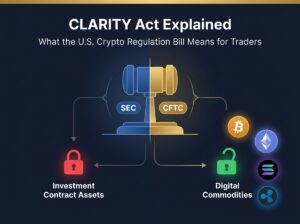
The first category is “digital commodities.” These are tokens whose underlying blockchain network is sufficiently decentralized — meaning no single person or coordinated group controls the network, its governance, or its token supply. Digital commodities are overseen by the CFTC. The bill sets out seven objective, measurable criteria for determining when a blockchain system has matured to the point where no one controls it. Tokens that meet these criteria are treated as commodities, not securities.
The second category is “investment contract assets.” These are tokens that are still part of an investment contract — typically tokens sold during fundraising rounds (like ICOs or token sales) where the buyer expects profits from the efforts of others. These remain under SEC jurisdiction and are subject to securities laws, including registration and disclosure requirements.
The third category is “permitted payment stablecoins.” These are dollar-pegged tokens that fall under banking regulators per the GENIUS Act (the stablecoin bill signed into law separately), with the SEC and CFTC retaining anti-fraud authority over stablecoin trades on their registered venues.
The critical innovation is the transition mechanism. A token can start as an investment contract asset (under SEC oversight) and transition to a digital commodity (under CFTC oversight) once its network meets the decentralization criteria. This is codified through a “Certification of Decentralization” process: an issuer files a certification with the SEC asserting that their network meets the statutory criteria, and the token receives a rebuttable presumption that it qualifies as a digital commodity. The SEC can challenge the certification, but only under specific evidentiary and procedural guidelines.
In March 2026, the SEC and CFTC jointly issued interpretive guidance classifying Bitcoin, Ethereum, Solana, XRP, and 12 other crypto assets as digital commodities. However, that was administrative guidance — a future SEC chair could reverse it with a memo. The CLARITY Act writes the classification framework into federal statute, making it reversible only by Congress.
SEC vs. CFTC: Who Regulates What
Under the CLARITY Act, the jurisdictional split is clean. The SEC retains authority over initial token sales (fundraising transactions that constitute investment contracts), ancillary asset disclosures (semi-annual reporting by token issuers about their project’s development and finances), insider trading (Section 109 of the bill preserves SEC Rule 10b-5 for primary offerings), and tokenized securities (Section 505 gives the SEC sole authority over tokenized versions of traditional securities).
The CFTC gains authority over secondary market trading of digital commodities (spot and derivatives), registration and oversight of Digital Commodity Exchanges (a new registration category), registration of brokers and dealers who handle digital commodity transactions, and market surveillance and anti-manipulation enforcement for digital commodity markets.
For traders, the practical implication is significant. When you buy ETH or SOL on an exchange, that transaction is regulated by the CFTC, not the SEC. The exchange must be registered as a Digital Commodity Exchange and comply with customer asset protection rules, market transparency requirements, and anti-manipulation standards. This is a lighter regulatory framework than SEC securities regulation, which is why the crypto industry broadly supports the bill.
Key Provisions That Affect Traders and Investors
Several specific provisions of the CLARITY Act have direct implications for market participants.
The first is mandatory disclosure requirements. Token issuers must publish initial and semi-annual disclosures covering the project’s development status, team, finances, token distribution, and governance structure. This brings transparency that currently does not exist for most crypto projects and helps investors make informed decisions.
The second is insider trading restrictions. Insiders — founders, early investors, team members — face selling restrictions until the blockchain system becomes “mature” (i.e., sufficiently decentralized). This is designed to prevent pump-and-dump behavior where insiders sell into retail demand during a token’s early stages.
The third is the stablecoin yield provision (Section 404). This was the most contentious part of the bill. The May 2026 text prohibits passive interest or yield payments for simply holding a stablecoin. However, it preserves activity-based rewards tied to transactions, payments, settlement, market-making, collateral posting, governance voting, validation, staking, and loyalty programs. Critically, permissible rewards “may be calculated by reference to a balance, duration, tenure, or any combination of the foregoing.” This means stablecoin rewards based on balance or holding duration are not automatically prohibited, as long as the underlying activity is bona fide.
The fourth is DeFi protections (Title III). The bill explicitly exempts DeFi protocols and applications from the registration requirements that apply to centralized intermediaries. It also provides statutory protections for validators, sequencers, oracle providers (like Chainlink and Pyth), node operators, and incident response/security councils. These entities are explicitly excluded from being classified as regulated intermediaries. A decentralized governance system (DAO) is not deemed to be a person or group of persons acting under common control — pushing back on enforcement theories that have treated DAO participation as evidence of concerted action.
The fifth is the Blockchain Regulatory Certainty Act (BRCA) in Section 604. Non-custodial software developers, self-custody hardware/software providers, and protocol developers receive immunity from money transmitter classification and prosecution under 18 U.S.C. 1960. The one exception: persons who act “with the specific intent to transfer, on behalf of another person, funds that are known by the initial person to be” derived from criminal activity. This high mens rea standard (specific intent plus actual knowledge) protects good-faith developers while preserving criminal prosecution for knowing facilitators.
The sixth is the insolvency safe harbor (Section 702, new in May 2026). Digital commodity transactions with institutional counterparties (commodity brokers, stockbrokers, financial institutions, securities clearing agencies) receive the same bankruptcy safe harbor protections that currently apply to swaps, repos, and securities contracts. This means counterparties can close out positions and exercise netting rights without being trapped by an automatic stay in bankruptcy. For institutional trading desks, this substantially reduces the legal risk premium built into every digital commodity transaction.
What This Means for Specific Tokens
Based on the SEC-CFTC joint interpretive guidance from March 2026 and the CLARITY Act’s framework, the following tokens would likely be classified as digital commodities under CFTC oversight: Bitcoin (BTC), Ethereum (ETH), Solana (SOL), XRP, Cardano (ADA), Chainlink (LINK), Avalanche (AVAX), and others that meet the decentralization criteria.
Tokens that are still raising capital, are controlled by a foundation or company, or do not meet the seven decentralization criteria would remain as investment contract assets under SEC oversight until they can file a Certification of Decentralization.
Stablecoins like USDC and USDT would be regulated under the GENIUS Act’s banking framework, separate from the CLARITY Act.
Where the Bill Stands: Path to Becoming Law
The CLARITY Act has a long legislative road ahead. The bill passed the House of Representatives on July 17, 2025, with a vote of 294-134 (all 216 Republicans plus 78 Democrats in favor). The Senate Banking Committee advanced the bill 15-9 on May 14, 2026. Next, the bill must pass the full Senate with 60 votes (to overcome the filibuster), be reconciled with the House version, and be signed by President Trump. The White House has targeted July 4, 2026, as a presidential signing date.
Several issues remain unresolved. Democrats are pressing for ethics provisions addressing elected officials (including President Trump) profiting from crypto. The banking industry opposes the stablecoin yield compromise, arguing it could draw deposits away from banks. Law enforcement groups want stronger anti-money laundering provisions. Senator Mark Warner (D-VA) said during the committee hearing that he was in “crypto purgatory” but looking forward to “getting to crypto heaven” — a signal that negotiations will continue on the Senate floor.
Polymarket was pricing passage by year-end at roughly 67-75% as of mid-May 2026. Galaxy Research’s base case is that the bill passes the full Senate in June or July 2026.
What This Means for Beginners
If you are new to crypto, the CLARITY Act matters for several reasons, even if you never read the bill’s 309 pages.
First, it means exchanges will be legally required to protect your assets. Under the bill, exchanges handling digital commodities must register with the CFTC and comply with customer asset protection rules. The FTX-style collapse — where customer funds were commingled and misused — becomes harder to repeat when exchanges face mandatory registration, surveillance, and governance requirements.
Second, it means you will have access to better information. Mandatory disclosures force token projects to publish their financials, development progress, and team information. This reduces the information asymmetry that currently favors insiders.
Third, it means more institutional money enters the market. The biggest single barrier to institutional crypto adoption has been regulatory uncertainty. When pension funds, endowments, and asset managers cannot determine whether buying ETH violates securities laws, they do not buy it. The CLARITY Act removes that barrier. More institutional capital generally means deeper liquidity, tighter spreads, and less extreme volatility.
Fourth, it signals that the U.S. is choosing to regulate rather than ban crypto. This is a structural positive for the entire asset class. Countries that regulate attract innovation; countries that ban push it underground or offshore.
If you are looking to start building positions in digital commodities ahead of the bill’s potential passage, platforms like Tapbit offer both spot and futures trading with low fees — a straightforward entry point for beginners who want to get exposure before the regulatory framework fully takes effect.
Conclusion
The CLARITY Act is not a crypto moonshot. It is plumbing — the kind of legal infrastructure that has to exist before the next wave of institutional capital, mainstream adoption, and product innovation can happen. It answers the question that has hung over U.S. crypto markets for a decade (is this a security or a commodity?) with a framework that uses objective criteria, assigns clear regulators, and protects both consumers and developers.
The bill is not yet law. Floor amendments, reconciliation with the House version, and a presidential signature all remain ahead. But the bipartisan committee vote on May 14 was the hardest step, and it passed. For the first time, U.S. crypto regulation is moving from enforcement memos to actual legislation — and that changes the calculus for everyone in the market.