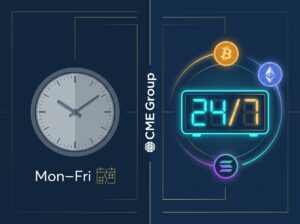
Starting Friday, May 29, 2026, at 4:02 p.m. Central Time, CME Group will switch its entire cryptocurrency futures and options suite to 24/7 continuous trading on CME Globex. This is not a minor schedule tweak. It eliminates a 46-hour weekend gap that has existed since CME launched Bitcoin futures in December 2017, a gap that spawned an entire sub-genre of technical analysis, forced institutional desks to price weekend risk into every trade, and left billions of dollars in hedges frozen while the spot market moved freely.
For beginners, this article explains what changes, why it matters, and what to watch. For more advanced readers, it covers the structural implications for basis trades, CME gap strategies, and the competitive landscape among regulated derivatives venues.
What Is Changing on May 29
Until now, CME crypto futures traded on a “23/5” schedule: Sunday 6:00 p.m. ET through Friday 5:00 p.m. ET, with a one-hour daily maintenance break. Every Friday evening, the market shut down completely and did not reopen until Sunday evening, creating an approximately 46-hour window in which no trading occurred on the world’s largest regulated derivatives exchange.
Starting May 29, CME crypto futures and options will trade continuously, seven days a week. The only interruptions are a two-minute daily maintenance window (4:00–4:02 p.m. CT, Monday through Friday) and a two-hour weekly maintenance window on Saturday (2:00–4:00 a.m. CT). Any trades executed on weekends or holidays will carry the next business day’s trade date for clearing, settlement, and regulatory reporting purposes.
Every crypto product currently listed on CME is included: Bitcoin (BTC), Ether (ETH), Solana (SOL), XRP, Cardano (ADA), Chainlink (LINK), Stellar (XLM), Avalanche (AVAX), and Sui (SUI) — both standard and micro-sized contracts, plus Bitcoin Friday futures, Spot-Quoted futures, and Ether/Bitcoin Ratio futures. The Bitcoin Volatility futures (BVX), launching June 1, will also follow the 24/7 schedule from inception.
Why This Matters: The CME Gap Problem
To understand why this is significant, you need to understand the “CME gap.”
Every Friday at 4:00 p.m. CT, CME crypto futures stopped trading. But Bitcoin and other cryptocurrencies continued trading around the clock on exchanges like Binance, Coinbase, and Kraken. Over any given weekend, Bitcoin could easily move 3–10% on thin liquidity, a geopolitical headline, or a liquidation cascade. When CME reopened Sunday evening, the futures price jumped to wherever spot had moved, leaving a visible blank space on the chart between Friday’s closing price and Sunday’s opening price.
Historical data from 2018 through early 2026 shows that approximately 70–80% of these gaps eventually “filled,” meaning Bitcoin’s price returned to the gap zone at some point after the gap formed. Smaller gaps (under $700) filled at an even higher rate — roughly 92% within 30 trading days. This statistical pattern turned CME gap trading into one of the most-watched technical strategies in crypto. Traders would note the gap level, wait for the price to approach it, and enter positions expecting a fill.
The problem was never the fill rate itself but the timing and the asymmetry. Some gaps filled within hours; others took weeks. About 20–30% never filled at all, trapping traders who assumed every gap would close. And for institutional desks running basis trades or hedging spot ETF exposure, the gap was not a trading opportunity — it was a risk management nightmare.
After May 29, new weekend gaps will stop forming. The futures chart will show continuous price action through Saturday and Sunday, just like spot exchanges already do. Historical unfilled gaps remain on the chart as reference levels, but no new weekly gaps will be generated.
The Institutional Hedging Revolution
The most impactful consequence of 24/7 trading is not chart pattern changes — it is the removal of unhedged weekend exposure for institutions.
Consider a fund that holds $100 million in spot Bitcoin (or a spot Bitcoin ETF like BlackRock’s IBIT) and hedges that position by shorting CME Bitcoin futures. Under the old schedule, if Bitcoin dropped 8% on a Saturday, the spot side lost $8 million while the futures hedge sat frozen until Sunday evening. For 46 hours, the hedge effectively did not exist. Risk managers at pension funds, endowments, and crypto-native asset managers have cited this structural gap as a primary barrier to larger crypto allocations.
Continuous trading eliminates that exposure gap. A portfolio manager can now adjust or close a hedge on Saturday morning, just as they would on a Tuesday afternoon. The practical effects include tighter hedging (reduced tracking error between spot and futures positions), larger potential allocations (with no weekend blind spot, risk committees may approve bigger positions), compressed basis spreads (the “weekend risk premium” that futures sellers demanded will decline, narrowing the spread between CME futures and spot/perp prices), and lower cost of carry for ETF arbitrage desks (market makers managing ETF inflows can now rebalance continuously).
Tim McCourt, CME Group’s Global Head of Equities, FX and Alternative Products, stated in the official announcement: “Client demand for risk management in the digital asset market is at an all-time high, driving a record $3 trillion in notional volume across our Cryptocurrency futures and options in 2025. Providing always-on access to our regulated, transparent Cryptocurrency products ensures clients can manage their exposure and trade with confidence at any time.”
CME’s Crypto Growth by the Numbers
The 24/7 launch is backed by data that shows explosive growth in CME’s crypto complex:
CME’s 2026 year-to-date crypto futures and options average daily volume (ADV) stands at 407,200 contracts, representing a 46% increase year-over-year. Futures-only ADV has reached 403,900 contracts, up 47%. Average daily open interest sits at 335,400 contracts, up 7% year-over-year. In 2025, CME recorded $3 trillion in total notional crypto volume. The Q1 2026 figure alone was $9.3 billion in notional volume per day across the crypto suite, with volume rising 57% in Q1 compared to the prior year.
The exchange now lists futures on ten crypto assets covering more than 75% of total crypto market capitalization. The most recent additions — Avalanche futures (standard: 5,000 AVAX; micro: 500 AVAX) and Sui futures (standard: 50,000 SUI; micro: 5,000 SUI) — went live on May 4, with first trades executed between FalconX and G-20 Group. Earlier in 2026, Cardano, Chainlink, and Stellar Lumens contracts had already crossed $200 million in cumulative volume since their February launch.
The breadth matters because 24/7 trading across all ten assets means institutional desks can manage multi-asset crypto portfolios with continuous hedging. A fund holding SOL, AVAX, and BTC no longer needs to worry about basis risk on any of them over the weekend.
The Competitive Landscape: CME vs. Coinbase vs. Kraken
CME is not the only exchange moving to 24/7 regulated crypto derivatives. The landscape is evolving rapidly.
Coinbase Derivatives became the first CFTC-regulated derivatives exchange to offer 24/7 futures trading in May 2025. Following its acquisition of Deribit (the world’s leading crypto options exchange with approximately $30 billion in open interest), Coinbase is building what it calls an “everything exchange” that spans spot, futures, perpetuals, and options on a single platform. Coinbase is actively working to introduce perpetual-style futures in the U.S.
Kraken’s parent company Payward completed its $550 million acquisition of Bitnomial on May 1, 2026, becoming the first entity to hold all three CFTC licenses required for a full derivatives stack: a futures commission merchant (FCM), a designated contract market (DCM), and a derivatives clearing organization (DCO). Arjun Sethi, co-CEO of Payward, stated the company plans to launch spot margin first, followed by perpetual futures and options, all under CFTC regulation.
CME’s response to this competitive pressure is clear. Terry Duffy, CME Group Chairman and CEO, emphasized on the Q1 2026 earnings call that perpetual futures are “illegal in the U.S.” under the Commodity Exchange Act of 2000, which defines a futures contract as one for “future delivery” rather than one “that never ends.” CFTC Chairman Michael Selig said in March 2026 that he has directed staff to clarify the classification of perpetual contracts, but noted that “certain asset classes may not be suitable for 24/7 trading and perpetual contracts.”
The bottom line for traders is that the U.S. regulated crypto derivatives market is fragmenting between monthly/quarterly-expiry futures (CME’s model) and the perpetual contracts (Coinbase/Kraken’s aspiration). Both models will coexist under increasing CFTC oversight.
What Beginners Should Know
If you are new to crypto and do not trade futures, here is what the CME 24/7 change means for you in practical terms.
First, weekend volatility may decrease over time. Historically, the worst single-day crypto drawdowns have clustered on weekends, when institutional liquidity was absent. Adding CME’s institutional order books to weekend hours should provide a stabilizing layer of liquidity, which means holding crypto over weekends becomes marginally less risky.
Second, the “CME gap” as a trading signal is fading. If you have followed crypto Twitter or YouTube, you have likely seen content about “filling the CME gap.” After May 29, new gaps stop forming. The concept becomes historical rather than actionable.
Third, this development is a sign of institutional maturation. Every structural barrier that is removed — weekend closures, limited product range, lack of 24/7 access — brings crypto closer to the operational norms of equities and commodities. This normalization tends to attract more long-term capital and reduce extreme volatility over time, which benefits all holders.
Fourth, you do not need to trade CME futures to benefit. The liquidity improvements and reduced weekend risk that CME 24/7 trading brings will ripple through the entire market, including the spot exchanges and wallets where most retail investors operate.
What to Watch After May 29
The first three weekends of 24/7 trading will be the most telling. Here are the key metrics to monitor.
Watch weekend volume on CME. If weekend futures volume ramps quickly toward 20–30% of weekday levels, it signals genuine institutional demand for continuous hedging. If it stays below 5%, the change is more symbolic than structural.
Monitor basis spread compression. If the futures premium (the difference between CME futures price and spot price) narrows after May 29, it confirms the weekend risk premium is being repriced. This is a direct measure of whether the structural change is working as intended.
Track weekend BTC volatility. Compare weekend price swings in June 2026 versus the same weekends in 2025. If the magnitude of moves decreases, it suggests CME liquidity is dampening the weekend volatility that has historically plagued crypto markets.
Finally, observe the first CME maintenance window gaps. The two-hour Saturday maintenance window (2:00–4:00 a.m. CT) could produce micro-gaps. Watch whether these create any tradeable patterns, though a two-hour window is unlikely to generate the significant dislocations that 46-hour closures produced.
Key Dates Ahead
May 29 (Fri): CME 24/7 crypto trading goes live at 4:02 p.m. CT. June 1 (Sun): CME Bitcoin Volatility futures (BVX) launch. These will also trade on the 24/7 schedule from day one.
Conclusion
The shift from 23/5 to 24/7 on CME closes one of the last remaining structural divides between traditional finance and the crypto-native market. For institutions, it removes the single biggest friction point in crypto hedging and should compress risk premiums baked into futures basis trades. For gap traders, eight years of a repeatable weekly setup comes to an end. For beginners and long-term holders, it signals that the crypto market infrastructure continues to mature, bringing with it the deeper liquidity and more efficient price discovery that larger markets enjoy.
This is not the kind of change that moves Bitcoin’s price on the day of launch. It is the kind of change that reshapes how all participants interact with the market over the following months and years.