Quick Summary
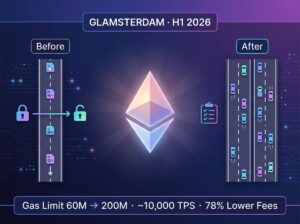
Ethereum’s next hard fork, Glamsterdam, targets H1 2026 (realistically July–September after the Soldøgn Interop devnet concluded May 2). It raises the gas limit from 60 million to 200 million, introduces on-chain block building through Enshrined Proposer-Builder Separation (ePBS), and enables parallel transaction processing via Block-Level Access Lists (BALs). The result is roughly 10x throughput, up to 78% lower gas fees, and up to 70% less MEV extraction. ETH trades near $2,350 as of mid-May 2026, and the upgrade arrives while the token sits well below its October 2025 high.
If you want to start trading ETH ahead of the upgrade, create a free account on Tapbit — a beginner-friendly exchange with low fees and 24/7 support.
What Is the Glamsterdam Upgrade?
Glamsterdam is the name for Ethereum’s upcoming hard fork, combining “Gloas” on the consensus layer and “Amsterdam” on the execution layer. It follows Pectra (May 2025) and Fusaka (December 2025), both of which shipped on time and focused primarily on Layer 2 scaling. Glamsterdam is different because it targets the base layer itself — how blocks are built, who builds them, and how the network processes transactions.
Vitalik Buterin outlined eight Ethereum Improvement Proposals (EIPs) in late February 2026 that define the upgrade’s full scope. The Ethereum Foundation’s meta EIP-7773 lists over 20 individual proposals across both layers, but two “headliners” anchor the release: EIP-7732 (ePBS) on the consensus side and EIP-7928 (BALs) on the execution side.
The Ethereum Foundation describes the upgrade as centering on three goals: speeding up processing through parallelization, expanding capacity by splitting the heavy lifting of block creation and verification, and preventing database bloat by adjusting fees to reflect long-term hardware costs.
How Ethereum Builds Blocks Today — and Why It Needs to Change
After The Merge in September 2022, Ethereum moved to proof-of-stake, where validators are assigned the right to propose blocks. But the actual job of assembling blocks — selecting transactions and ordering them — became a separate, specialized activity. Today, 80–90% of Ethereum’s block production runs through external relay infrastructure like MEV-Boost, operated by companies such as Flashbots.
This creates two problems. First, the validator-builder relationship sits entirely outside the protocol on a “trust me” basis with no cryptographic guarantee. Builders trust relays not to steal their strategies; validators trust relays to deliver blocks on time. Second, this off-chain coordination introduces a “hot path” bottleneck that forces block validation into a tight 2-second window, limiting how much data the network can handle.
The result is a transaction ordering process that has become highly profitable through maximal extractable value (MEV). Studies estimate the top three builders control more than 80% of all PBS blocks. If you have ever had a DEX swap execute at a worse price than quoted, that is MEV at work — bots front-running or sandwiching your transaction to extract profit.
Headliner 1 — Enshrined Proposer-Builder Separation (ePBS, EIP-7732)
What It Does
EIP-7732 moves the proposer-builder deal from off-chain relays into the Ethereum protocol itself. Under ePBS, the process works like a commit-reveal pipeline. Builders construct candidate blocks and publish bids on a new gossip topic. Each bid includes the value offered to the proposer, a payload commitment (a hash of the execution payload), and the builder’s signature. The proposer selects the highest bid without seeing the transaction contents. A subset of validators called the Payload Timeliness Committee (PTC) verifies that the builder revealed the payload on time and that its hash matches the earlier commitment.
If the builder fails to reveal the payload or delivers it late, the slot is recorded as empty, the proposer keeps the bid payment, and the builder loses the full value of their bid. No relay or third party is involved — Ethereum enforces the outcome directly on-chain.
Why It Matters for Regular Users
The most immediate benefit is reduced MEV. Researchers estimate ePBS could cut MEV extraction by up to 70%, which means fairer execution for anyone trading, borrowing, or providing liquidity on Ethereum. Beyond MEV, ePBS expands the data propagation window from 2 seconds to roughly 9 seconds, giving the network significantly more headroom to process larger blocks. This is the structural change that makes a 200-million gas limit realistic.
For institutional participants, ePBS means block production becomes auditable and rule-bound rather than dependent on the goodwill of intermediaries. By mid-2025, over 50% of high-value Ethereum transactions were being routed through private channels specifically to avoid MEV — a workaround that suggests the current system lacks the predictability some participants require.
What ePBS Does Not Solve
ePBS makes MEV more transparent but does not eliminate the underlying incentive to extract value from transaction ordering. A January 2026 academic paper modeling ePBS shows that while it reduces validator-side concentration, it “significantly amplifies profit and content centralization” among builders because access to private order flow still confers a structural bidding edge. The next step, FOCIL (Fork-Choice Enforced Inclusion Lists), has been moved to the Hegotá upgrade later in 2026 to avoid delaying Glamsterdam.
Headliner 2 — Block-Level Access Lists (BALs, EIP-7928)
What It Does
Ethereum currently processes transactions sequentially because nodes do not know which accounts or storage slots a transaction will touch until it actually runs. Think of it as a single-lane road where every car must pass one at a time because nobody knows which lanes each car needs.
EIP-7928 introduces Block-Level Access Lists — essentially a map included in every block that declares upfront which accounts and storage slots will be accessed. Nodes can then preload all necessary data at once (instead of discovering it step-by-step) and execute non-conflicting transactions in parallel, like opening multiple lanes on a highway.
The gas limit rises from 60 million to 200 million per block. Combined with parallel processing, this targets approximately 10,000 transactions per second — roughly 10x Ethereum’s current throughput.
Why It Matters
BALs do not just speed up processing. They also enable “executionless sync,” where new nodes joining the network can update their records by reading the final results included in BALs without replaying every transaction from scratch. This makes it faster and cheaper to run a node, which supports Ethereum’s decentralization goals.
For future upgrades, BALs are foundational. Parallel execution, ZK-proof-based verification, and segmented state designs all depend on knowing a block’s state footprint in advance. Glamsterdam does not deliver all of these, but it removes the structural bottleneck that prevented them from being deployed safely.
Gas Fees Drop Significantly
EIP-7904 reprices gas costs to reflect actual computational resources on modern hardware. Many current gas prices were set years ago and no longer match real execution costs. The recalibration produces a reduction of up to 78% across both simple ETH transfers and complex smart contract interactions.
A separate proposal, EIP-2780, reduces the base intrinsic gas cost for a simple ETH transfer by up to 71%. In practical terms, a Uniswap trade that currently costs $3–8 in gas could drop below $1, and multi-step DeFi operations would see proportionally larger savings.
The upgrade also introduces a “reservoir model” (EIP-8037) that separates state-creation gas costs from execution gas. Until now, deploying a new contract or opening a new storage slot consumed the same type of gas as running computations, which meant scaling compute capacity inevitably bloated Ethereum’s state database. By decoupling these costs and introducing dynamic pricing tied to actual data size, Ethereum can increase throughput without proportionally growing the state — targeting a sustainable growth rate of approximately 100 GiB per year.
Other Notable Changes in Glamsterdam
Beyond the two headliners and gas repricing, the EIP-7773 meta proposal includes several improvements worth noting. EIP-8061 increases the exit churn limit from 256 ETH per epoch to roughly 1,187 ETH (a 4.6x increase), meaning institutional stakers can exit large positions in days rather than weeks. EIP-8080 democratizes the consolidation queue so that all validators, not just high-balance ones, can use the fastest available exit path. EIP-8045 excludes slashed validators from being selected to propose future blocks, preventing guaranteed missed slots during mass-slashing events. EIP-7708 makes ETH transfers and burns emit standard log events, fixing a long-standing blind spot that forced exchanges and bridges to use custom tracing tools. And EIP-7997 introduces a deterministic factory contract at address 0x12, allowing developers to deploy smart contracts to the exact same address across all EVM-compatible chains.
Where Does Testing Stand Right Now?
As of early May 2026, the Soldøgn Interop devnet concluded on May 2 in Svalbard, Norway. Eight different software clients achieved cross-client interoperability, and all main Glamsterdam components ran together in the same test environment for the first time. Devnet-4 testing is complete and Devnet-5 is underway.
The next milestones are public testnet activations on Holesky and Sepolia, followed by 30-day security audits. If public testnets launch in late May or early June, the June mainnet window is still possible. However, most developers now expect July to September as the more realistic activation window. The Ethereum Foundation has not confirmed an exact mainnet date.
What Comes After Glamsterdam — The Hegotá Upgrade
The Ethereum Foundation has committed to a biannual upgrade cadence for 2026. Hegotá, targeting H2 2026, is designed as the complementary second half of this year’s development push. Its headline feature is Verkle Trees, a data structure swap that could slash node storage requirements by approximately 90%. Today, running an Ethereum node requires downloading and maintaining over a terabyte of state data. Verkle Trees would enable “stateless clients” where new nodes join the network and begin validating without downloading full state history.
Hegotá also picks up FOCIL (Fork-Choice Enforced Inclusion Lists), the censorship-resistance feature originally considered for Glamsterdam. FOCIL would give validators the power to force certain transactions through even if a builder tries to exclude them.
Together, Glamsterdam advances “The Surge” (execution scaling) while Hegotá advances “The Verge” (statelessness and verification). If both ship on schedule, 2026 becomes Ethereum’s most comprehensive year of infrastructure development since the transition from proof of work.
How Past Upgrades Affected ETH Price
No two Ethereum upgrades produce identical price action, but the historical pattern is worth understanding. The Merge in September 2022 saw ETH rally over 100% into activation, then drop roughly 15% afterward in a classic “buy the rumor, sell the news” event. Shapella in April 2023 defied that pattern entirely, rallying 10% post-fork as the market valued de-risking over feared sell pressure. Dencun in early 2024 produced about 60% pre-fork gains.
Glamsterdam arrives with ETH near $2,350, well below the October 2025 high above $3,600. The key difference is starting position — ETH is already beaten down rather than riding momentum into the upgrade. That changes the risk profile. The structural case connects through three channels: lower fees should revive on-chain activity and increase EIP-1559 fee burns (tightening supply), the throughput improvement closes the competitive gap with Solana that has been a persistent narrative headwind, and roughly 30% of ETH supply is locked in staking with institutional products like BlackRock’s ETHA holding significant positions.
The risks are equally real. A timeline delay to Q3 or Q4 would likely trigger a short-term selloff. Sell-the-news dynamics have followed every major fork since The Merge. And macro headwinds can override any single upgrade. For more on reading market signals without making emotional decisions, see our guide on how to read crypto news without emotional trades.
What Should Beginners Do?
If you are new to Ethereum, the most important takeaway is that you do not need to do anything with your ETH when Glamsterdam activates. Your balance stays the same, your wallet works the same, and no “swap” or “upgrade” action is required. Anyone telling you otherwise is running a scam.
What you can do is use this period to understand how Ethereum works and why infrastructure upgrades matter for the long-term value proposition. If you are considering buying ETH, historical patterns suggest that patient accumulation during macro-driven dips — while upgrade milestones stay on track — has offered the strongest risk-adjusted entries in past cycles. Dollar-cost averaging remains one of the simplest approaches. For a detailed breakdown of how DCA works, read our guide on what is dollar-cost averaging and why it still works in 2026.
Monitor two signals in the coming weeks. First, watch for the Holesky and Sepolia testnet activation dates — if they launch in late May or June, the mainnet window holds. Second, track ETH price behavior around the $2,500 level; sustained buying above that zone heading into testnet dates would be the clearest market signal that capital is pricing a successful activation.
Ready to start? Sign up on Tapbit and explore ETH spot trading with low fees and a simple interface designed for beginners.